For decades, cystic fibrosis (CF) was a death sentence for children. In the 1960s, most kids with CF didn’t live past their teens. Today, thanks to a revolution in medicine, many people with CF are reaching their 50s and beyond. The shift didn’t come from better lung machines or stronger antibiotics-it came from understanding the root cause: a single faulty gene.
What Exactly Is Cystic Fibrosis?
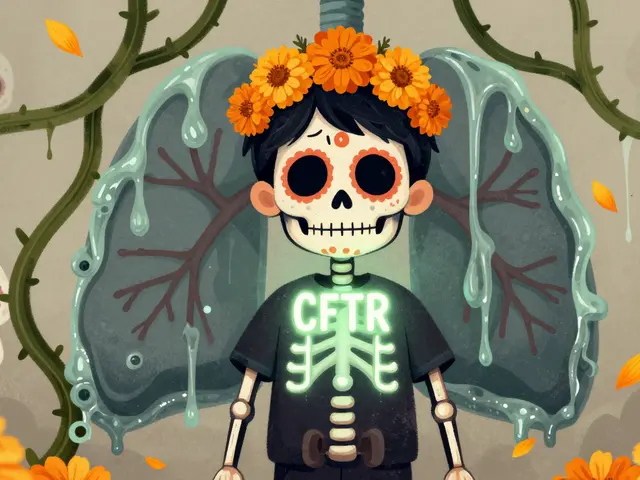
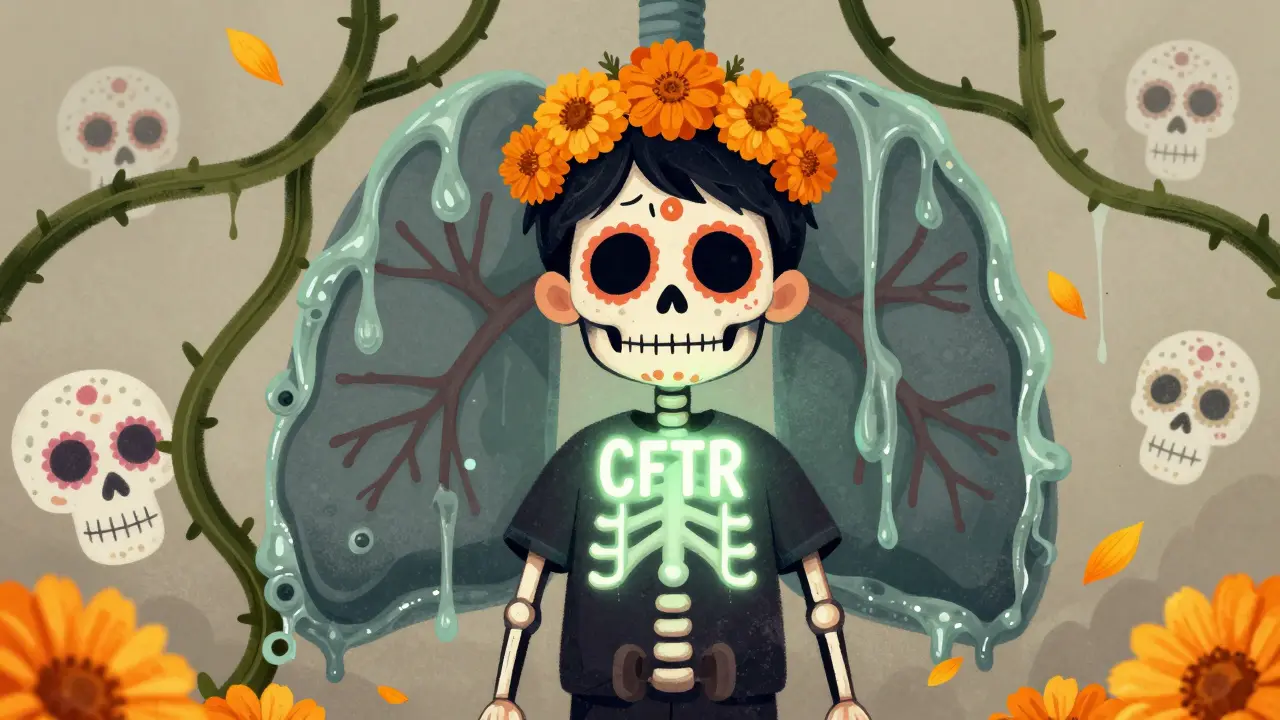
Cystic fibrosis is not just a lung disease. It’s a genetic disorder that messes up how salt and water move in and out of your cells. This happens because of mutations in the CFTR gene, which stands for cystic fibrosis transmembrane conductance regulator. When this gene doesn’t work right, mucus becomes thick and sticky instead of thin and slippery. That thick mucus clogs the lungs, pancreas, liver, and even the reproductive system.
The most common mutation, called F508del, affects about 70% of people with CF worldwide. But there are over 2,000 known mutations in the CFTR gene, and each one behaves a little differently. Some barely affect the protein. Others completely break it. That’s why treatment isn’t one-size-fits-all.
CF is inherited. Both parents must carry a faulty copy of the gene for a child to have the disease. Carriers-people with just one bad copy-don’t show symptoms. That’s why CF can pop up in families with no history of it. Newborn screening, now standard in all 50 U.S. states since 2010, catches CF early by testing for high salt levels in sweat. A result above 60 mmol/L confirms the diagnosis.
How CF Destroys the Body
Think of your lungs as a system that needs to stay moist and clear. In CF, the mucus that should help trap dirt and germs turns into glue. It sticks to the airways, making it impossible for the tiny hair-like structures (cilia) to sweep out bacteria. That’s why people with CF get constant lung infections. The usual suspects are Pseudomonas aeruginosa and Staphylococcus aureus. Over time, these infections cause permanent scarring-called bronchiectasis-and slowly destroy lung function.
The pancreas gets clogged too. Digestive enzymes can’t reach the intestines, so food doesn’t break down. About 85% of people with CF need to take pancreatic enzyme pills with every meal-sometimes 12 capsules a day. Without them, they lose weight, even if they’re eating plenty. Malnutrition is common. The liver can get damaged when bile ducts harden, and about 30% of adults with CF develop liver problems. And for men, nearly all are infertile because they’re born without the tube that carries sperm.
Compared to other genetic lung diseases like Primary Ciliary Dyskinesia (PCD), CF is different. PCD breaks the cilia themselves. CF breaks the mucus. That’s why CF has treatments now-and PCD doesn’t.
The Breakthrough: CFTR Modulators
The game-changer came in 2012 with the approval of ivacaftor (Kalydeco). For the first time, a drug didn’t just treat symptoms-it fixed the broken protein at the molecular level. It worked only for people with the rare G551D mutation. But it proved the concept: if you can fix the CFTR protein, you can change the disease.
Then came the triple combo: elexacaftor/tezacaftor/ivacaftor (Trikafta). Approved in 2019, it works for people with at least one F508del mutation-which covers about 90% of the CF population. In clinical trials, Trikafta boosted lung function (FEV1) by 13.8% on average. That’s not a small improvement. It’s life-changing. People who once needed oxygen tanks could hike. Those who spent hours every day on airway clearance now do it in 20 minutes. One patient reported going from 90 minutes of daily breathing therapy to 20. That’s 70 minutes of your life back.
By 2023, 90% of people with CF in the U.S. had access to at least one modulator. Median survival jumped from 14 years in 1960 to 50.9 years in 2022. That’s a 36.9-year increase in just over half a century. It’s the most dramatic survival gain ever seen in a chronic disease.

The Dark Side of Progress
But this miracle isn’t for everyone. About 10% of people with CF have mutations that don’t respond to any current modulator. These are often rare or severe mutations-like nonsense mutations that stop protein production entirely. For them, the old treatments remain: chest physiotherapy, nebulizers, antibiotics, and enzyme pills. The daily burden? Two to three hours of care. And that’s without complications.
Then there’s the cost. Trikafta and its cousins cost around $300,000 per year in the U.S. Even with insurance, out-of-pocket costs can hit $1,200 a month. A 2022 survey of 7,842 CF patients found 42% struggled with financial strain. In low-income countries, fewer than 10% have access. The World Health Organization calls this inequity “unacceptable.”
Side effects are real too. Some patients develop liver enzyme spikes, forcing them to stop treatment. Others report headaches, dizziness, or cataracts. In clinical trials, 3.2% of users had to discontinue due to safety issues. For some, the trade-off isn’t worth it.
What’s Next? The Future of CF Treatment
Researchers aren’t stopping. The Cystic Fibrosis Foundation is funding 15 active clinical trials right now. One targets nonsense mutations with Ataluren, a drug that helps cells ignore stop signals in the gene. Another uses CRISPR gene editing to fix the CFTR gene directly-trial CTX110 is already in early human testing. There’s also work on mRNA therapies to deliver working copies of the gene.
New drugs are being tested for hard-to-treat infections. Aradigm’s Liposomal Ciprofloxacin, for example, is designed to penetrate thick mucus and kill Pseudomonas more effectively. And in January 2023, Trikafta got approved for kids as young as 2-expanding coverage to 90% of the CF population across all ages.
But the real goal? A cure. The Foundation has pledged $100 million to its “Path to a Cure” initiative, focused entirely on the 10% left behind. If they can fix the remaining mutations, the entire CF population could live full, healthy lives.

Living with CF Today
Today, over half of all people with CF are adults. That’s a radical shift from 1990, when only 27% were adults. This isn’t just about living longer-it’s about living better. People with CF are going to college, having careers, and starting families. Many use fertility treatments to have children. Support networks are stronger than ever: 260 accredited care centers in the U.S., 24/7 clinical help lines, and online communities like CF Buddy Connect with over 12,500 active users.
Still, the daily grind doesn’t disappear. Even with modulators, many still need inhaled medications, nutritional supplements, and regular checkups. Adherence is a challenge-only 65-75% stick to their full regimen. That’s why education and support matter as much as drugs.
Why This Matters Beyond CF
Cystic fibrosis is no longer just a rare disease. It’s a blueprint. It’s the first condition where precision medicine worked at scale. The same approaches being used for CF are now being tested for other genetic disorders-like spinal muscular atrophy and certain forms of inherited blindness. The $750 million invested by the CF Foundation since 1989 didn’t just save lives-it built a new model for drug development. Venture philanthropy, public-private partnerships, and patient-led research are now standard tools in medical innovation.
And yet, the biggest lesson is simple: if you understand the root cause, you can fix it. CF taught us that.
Can cystic fibrosis be cured?
There is no cure yet, but CFTR modulator therapies can control the disease so effectively that many people live nearly normal lifespans. For the 10% of patients with mutations not covered by current drugs, researchers are testing gene editing and mRNA therapies that may one day offer a true cure.
Is CF only a lung disease?
No. While lung problems are the most life-threatening, CF affects multiple organs. Thick mucus blocks the pancreas (causing digestive issues), liver (leading to cirrhosis), and reproductive system (causing infertility in men). It also causes very salty sweat, which is how it’s diagnosed.
How do CFTR modulators work?
They fix the faulty CFTR protein. Some modulators help the protein reach the cell surface (correctors like elexacaftor), while others help it function once there (potentiators like ivacaftor). The triple combo does both, restoring chloride flow and thinning mucus.
Why is Trikafta so expensive?
It’s a complex drug developed over decades with high research costs. Vertex Pharmaceuticals holds nearly all the patents and has exclusive rights. In the U.S., it costs about $300,000 per year. Insurance helps, but many patients still pay over $1,000 monthly out-of-pocket. Access is extremely limited in low-income countries.
Are there side effects to CFTR modulators?
Yes. Common ones include headaches, nausea, and liver enzyme increases. In 3.2% of patients, liver damage was severe enough to require stopping the drug. Long-term risks like cataracts are still being studied. Benefits usually outweigh risks, but each patient must be monitored closely.
Can someone with CF have children?
Women with CF can often become pregnant, though pregnancy carries higher risks. Men with CF are almost always infertile due to missing vas deferens, but they can father biological children using sperm extraction and IVF. Genetic counseling is recommended before trying to conceive.
What’s the difference between CF and PCD?
Both cause chronic lung infections, but they’re different. CF is caused by a gene defect that makes mucus thick. PCD is caused by broken cilia-the tiny hairs that sweep mucus out. CF has targeted drugs; PCD does not. Diagnosis and treatment differ significantly.
How is CF diagnosed?
Most cases are found through newborn screening, which tests sweat chloride levels. A result over 60 mmol/L confirms CF. Genetic testing identifies the specific mutations. In older patients, symptoms like recurrent pneumonia, poor growth, or salty skin lead to testing.
Is CF becoming more common?
No-the number of diagnosed cases is stable at around 105,000 globally. But more people are living longer, so the adult population is growing. Today, over half of all CF patients are adults, compared to just 27% in 1990.
What’s the biggest challenge in CF care today?
Access. While 85% of U.S. patients get modulators, fewer than 10% in low-income countries do. Cost, lack of infrastructure, and patent restrictions create a global divide. The same drugs that save lives in Canada or Germany are out of reach for most people in Africa, Asia, and Latin America.
For those living with CF today, the future is brighter than ever. But it’s not just about the science-it’s about fairness. Every person, no matter where they live, deserves the chance to breathe easier.