Alopecia areata isn't just about losing hair-it's about your immune system turning on your own hair follicles. Picture this: your body, which normally protects you from viruses and bacteria, suddenly decides your scalp, eyebrows, or beard are the enemy. The result? Sudden, round patches of baldness that appear overnight. No itching, no scaling, no redness-just smooth, bare skin where hair used to be. It’s not contagious. It’s not caused by stress alone. And it’s not something you can just ‘tough out.’ This is autoimmune hair loss, and it affects nearly 7 million people in the U.S. alone.
What Really Happens in Your Scalp?
In a normal hair cycle, follicles go through growth (anagen), transition (catagen), and rest (telogen). In alopecia areata, that cycle gets hijacked. Immune cells-mainly CD8+ T cells-cluster around the base of the hair follicle like a swarm, attacking it as if it’s infected. The follicle doesn’t die, but it shuts down. It stops producing hair and goes into early rest mode. That’s why the hair loss is nonscarring: the follicle is still alive. That’s also why regrowth is possible, even after years of complete baldness.
The classic sign? A coin-sized, smooth bald patch on the scalp. But it doesn’t stop there. Some people lose all scalp hair (alopecia totalis). Others lose every hair on their body, including eyelashes and eyebrows (alopecia universalis). Then there’s ophiasis-a band of hair loss around the sides and back of the head-that’s harder to treat and often more persistent. Nail changes are also common: tiny pits, ridges, or rough surfaces. About 1 in 3 people with alopecia areata will notice these nail changes, even if their hair loss is mild.
Why Is This So Hard to Predict?
Unlike male pattern baldness, which follows a clear genetic and hormonal pattern, alopecia areata is unpredictable. One person might lose a single patch and regrow hair in three months. Another might lose everything and never get it back. Why? Because it’s not just about genetics-it’s about immune triggers. Stress, infections, or even environmental factors can flip the switch in someone who’s genetically predisposed.
Research shows that about 20% of people feel tingling, burning, or itching on their scalp right before hair starts falling out. That’s your immune system warming up. And while the condition can strike at any age, half of all cases begin before age 40. Men and women are equally affected, but women tend to experience more severe forms, possibly because of hormonal interactions with immune pathways.
What makes this condition so frustrating isn’t just the hair loss-it’s the uncertainty. You can’t know if a treatment will work until you’ve tried it for months. And even then, it might not stick.
Treatment Options: What Actually Works?
There’s no cure for alopecia areata-but there are treatments that can help. And the options have changed dramatically in the last five years.
Intralesional Corticosteroid Injections
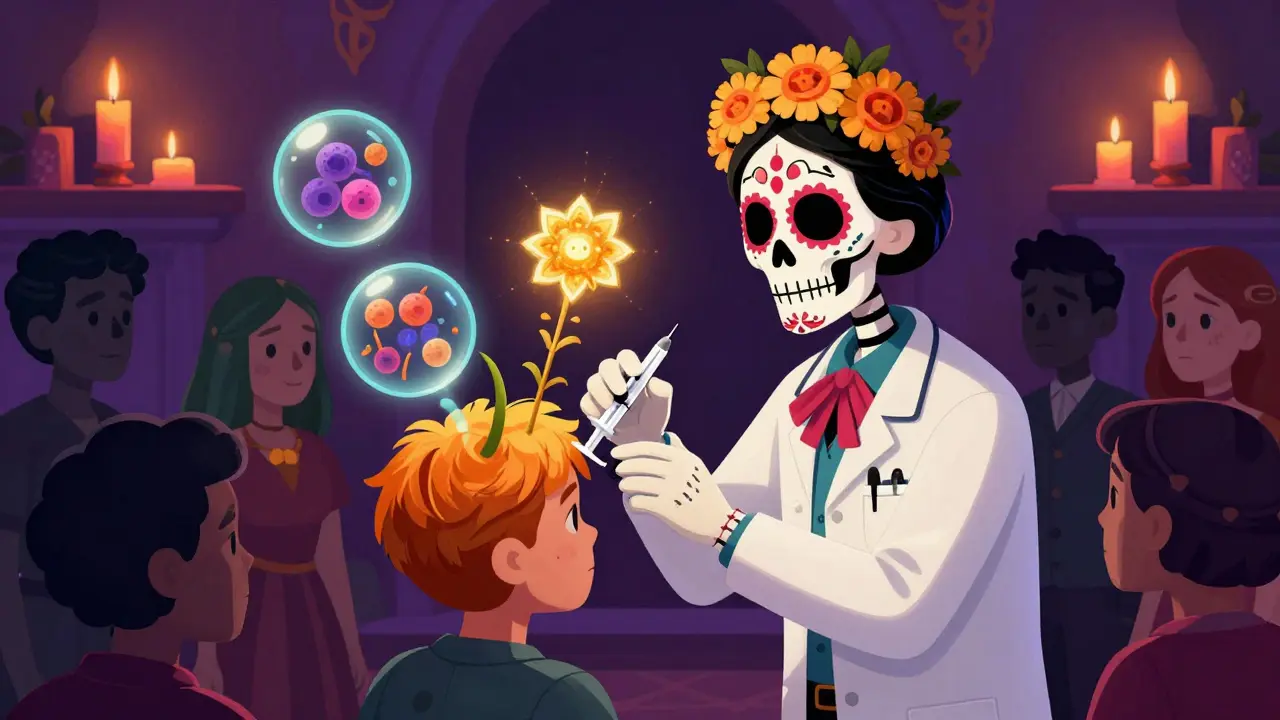
This is still the most common first-line treatment for patchy alopecia areata. A dermatologist injects a diluted steroid-usually triamcinolone acetonide-directly into the bald patches every 4 to 6 weeks. It works by calming the immune attack right where it’s happening. Studies show 60 to 67% of people with limited patchy loss see regrowth within 3 to 6 months. But it’s not magic. It only works on small areas. You can’t inject your whole scalp. And it’s painful. Multiple injections in one session feel like a series of sharp pinpricks.
Topical Treatments: Slow and Steady
Corticosteroid creams or lotions (like 0.1% betamethasone valerate) are less invasive but also less effective. They require daily use for 6 to 12 months before you might see results-and even then, only 25 to 30% of people respond. Minoxidil (Rogaine) is often added on top, but its success rate for alopecia areata is only 0 to 15% in extensive cases. It’s better for maintaining regrowth than starting it.
Contact Immunotherapy: Triggering an Allergy to Save Hair
This sounds counterintuitive, but it’s been used for decades. Doctors apply a chemical called diphenylcyclopropenone (DPCP) to the scalp weekly. It causes a controlled allergic reaction-redness, itching, blistering-which somehow distracts the immune system from attacking hair follicles. About 30 to 60% of patients see regrowth after 6 to 12 months. But the side effects are rough: intense itching, swollen lymph nodes, and skin irritation. Not for everyone.
JAK Inhibitors: The Game Changer
The biggest breakthrough came in 2022 with the FDA approval of baricitinib (Olumiant), the first oral drug specifically approved for severe alopecia areata. It blocks JAK enzymes-key players in the immune signaling pathway that attacks hair follicles. In clinical trials, 35.6% of patients with severe hair loss achieved 80% scalp coverage in 36 weeks. That’s life-changing for people who lost everything.
Then in June 2023, ritlecitinib got approved too. In trials, nearly 30% of patients reached 80% regrowth in just 24 weeks. These drugs aren’t perfect. They cost $10,000 to $15,000 a month. Insurance often denies coverage unless you’ve tried everything else. And they don’t fix the root cause-they just suppress the attack. When you stop taking them, hair loss usually returns within a year for 75% of people.
What Doesn’t Work (And Why People Keep Trying)
There’s a lot of noise out there. Essential oils. Scalp massages. Gluten-free diets. Acupuncture. Some people swear by them. But here’s the truth: none have solid scientific backing. A 2023 review in the Journal of the American Academy of Dermatology found no reliable evidence that any alternative therapy consistently regrows hair in alopecia areata.
Why do people still try? Because hope is powerful. And when conventional treatments fail-or take too long-people grab at anything that feels like a lifeline. The emotional toll is real. A 2022 survey by the National Alopecia Areata Foundation found 68% of patients avoided social situations because of their appearance. 28% had been diagnosed with clinical depression. That’s why mental health support is just as important as medical treatment.

The Future: Personalized Medicine on the Horizon
Researchers are no longer just treating symptoms. They’re trying to understand why it happens in the first place. Studies at Columbia University and elsewhere are identifying genetic markers-like ULBP3 and ULBP6-that may predict who’s more likely to develop severe forms. By 2025, doctors may be able to run a simple blood test to tell you whether you’re likely to respond to JAK inhibitors, corticosteroids, or something else.
Combination therapies are also being tested: JAK inhibitors plus topical immunotherapy, or low-dose steroids with light therapy. The goal isn’t just regrowth-it’s long-term remission. The National Alopecia Areata Foundation predicts a 50% drop in disease burden by 2030, thanks to these new approaches.
For now, the message is this: you’re not alone. And you’re not broken. Your immune system made a mistake. But science is catching up.
What to Do If You Think You Have It
- See a dermatologist-preferably one who specializes in hair disorders. Don’t wait. Early treatment gives you the best shot at regrowth.
- Get your nails checked. Nail changes are a silent clue.
- Don’t panic if you lose more hair after starting treatment. It’s common. Your immune system is reacting.
- Join a support group. Talking to others who get it makes a huge difference.
- Ask about clinical trials. New drugs are always testing. You might qualify.
Regrowth doesn’t always mean your hair comes back exactly how it was. Some people report gray or white hair first, then color slowly returns. That’s normal. It’s not a sign the treatment failed-it’s a sign your follicles are waking up.