When a drug first hits the market, the company that made it gets a 20-year patent on the active ingredient. That’s the primary patent. But by the time that patent is about to expire, the brand usually has a whole new set of patents lined up - not on the medicine itself, but on tiny changes to it. These are called secondary patents. And they’re the main reason why some drugs stay expensive for years after they should have gone generic.
What Exactly Are Secondary Patents?
Secondary patents don’t protect the chemical that makes the drug work. They protect things like how it’s shaped, when you take it, what it’s mixed with, or even what disease it’s used to treat. Think of it like changing the packaging, not the product inside. A pill might be the same, but if it’s now a slow-release tablet instead of a quick-dissolve one, the company can file a new patent. That’s a formulation patent. If the same drug is now approved for treating a new condition - say, rheumatoid arthritis instead of just depression - that’s a method-of-use patent.
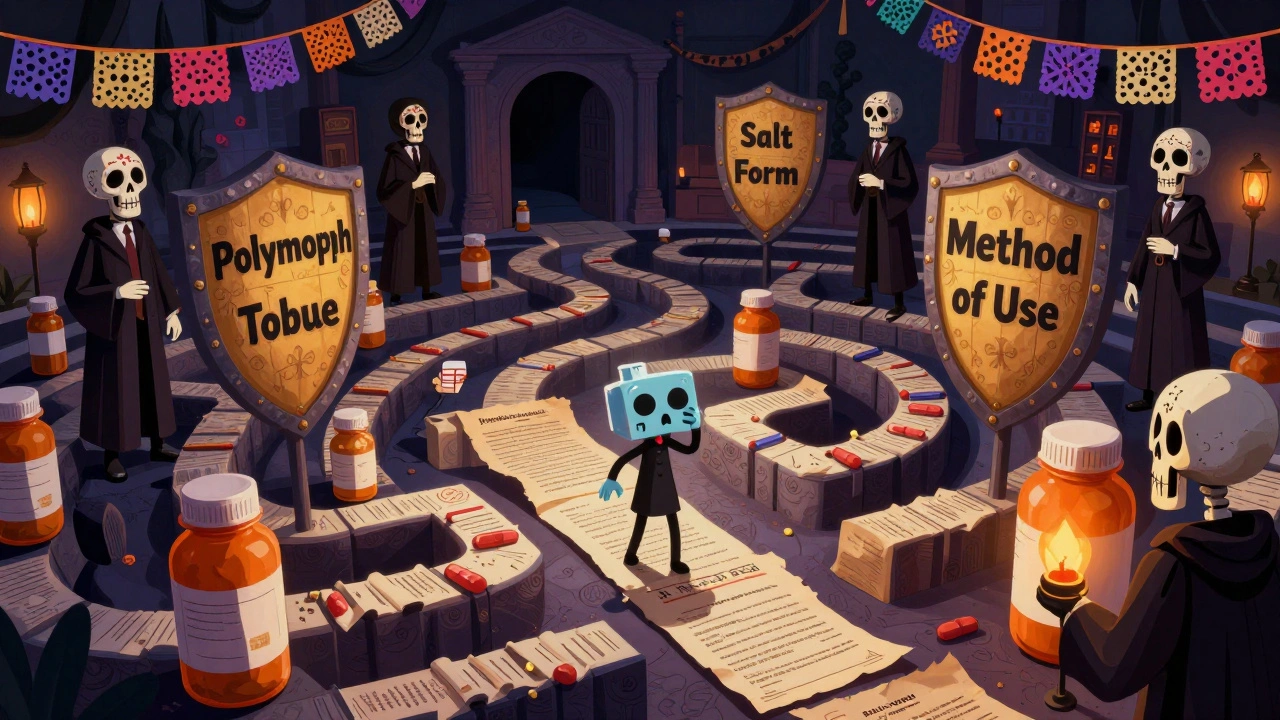
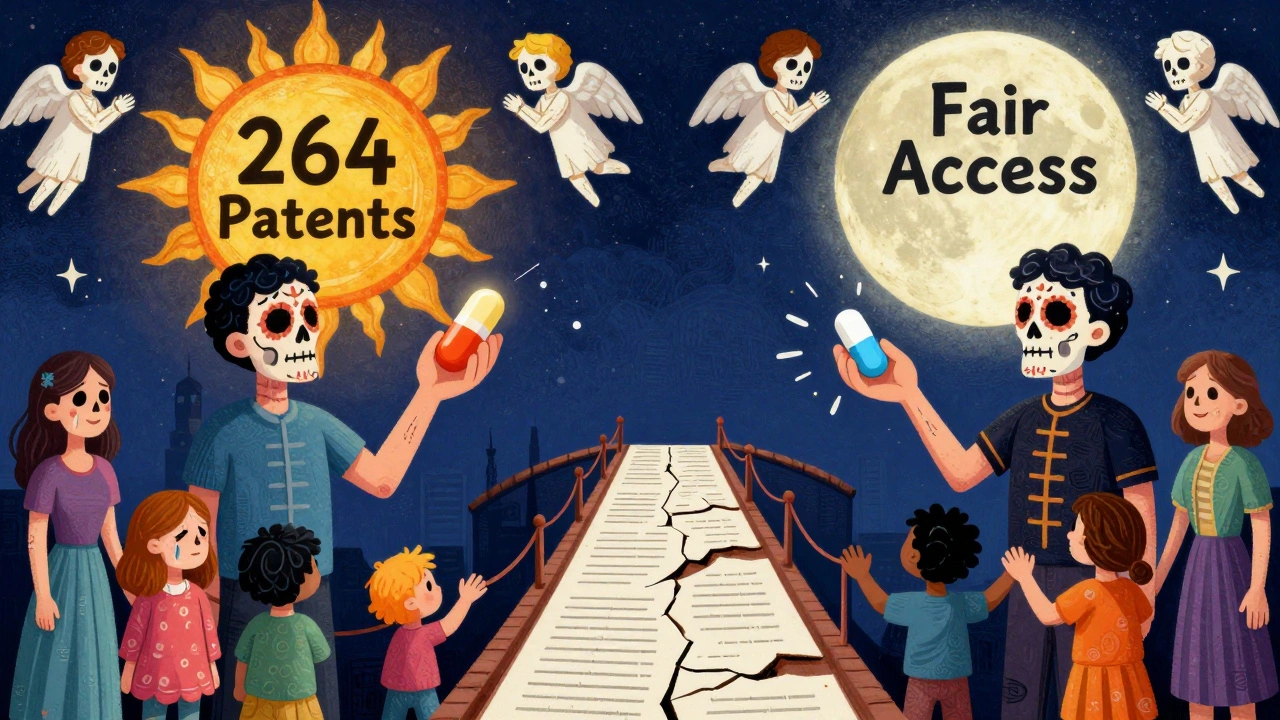
There are over a dozen types of secondary patents. Polymorphs - different crystal structures of the same molecule - are common. Salts and esters? Those are chemical tweaks that make the drug absorb better. Even a new manufacturing process can be patented, even if the FDA doesn’t list it in their public database. The result? A single drug can be wrapped in 50, 100, even 264 patents. Humira, for example, had 264 secondary patents protecting it long after its original patent expired.
Why Do Companies Use Them?
It’s simple: money. A blockbuster drug can make $10 billion a year. Letting generics in means that revenue drops by 80% almost overnight. Secondary patents delay that drop. On average, they extend market exclusivity by 2.3 years. For drugs without strong primary patents, they can add up to 11 extra years of protection.
It’s not random. Companies plan this years in advance. Lifecycle management teams start filing secondary patents five to seven years before the primary patent expires. They time the launch of a new version - maybe a once-daily pill instead of two - just 1-2 years before generics are due. That’s called “product hopping.” Patients get switched to the new version. Doctors get used to prescribing it. Insurance plans start covering it. By the time the old version goes generic, no one wants it anymore.
PhRMA argues this drives innovation. They say new formulations mean fewer side effects, better dosing, or new uses for old drugs. And sometimes, that’s true. A new version of a chemo drug might reduce nausea by 37%. That’s meaningful. But a 2016 Harvard study found only 12% of secondary patents led to real clinical improvements. The rest? Just legal maneuvers.
How They Block Generic Drugs
Generic manufacturers don’t just wait for the primary patent to expire. They have to dig through a maze of secondary patents. The FDA’s Orange Book lists only certain types - mainly formulations and method-of-use patents. But companies keep others hidden, like manufacturing process patents, as backup. When a generic company files to sell a copy, the brand sues. And they don’t just sue once. They sue on multiple patents at once. This forces generics to spend millions in legal fees and delays their entry by years.
The numbers are brutal. Generic drugmakers say it takes an extra 3.2 years on average to get a product to market because of secondary patent fights. Legal costs jump by $15-20 million per drug. And even when generics win in court, the damage is done. By then, the brand has already locked in pricing and loyalty. In 2022, 92% of listed secondary patents were challenged by generics - but only 38% of those challenges succeeded.
Where It Works - And Where It Doesn’t
Not every country lets this happen. In the U.S., the Hatch-Waxman Act of 1984 created the system that made secondary patents possible. It gave brands a legal pathway to delay generics. But in India, the rules are different. Section 3(d) of their patent law says you can’t patent a new form of an existing drug unless it shows significantly better effectiveness. That’s why Novartis lost its bid to patent a new version of Gleevec in 2013. The Indian court said the new crystal form wasn’t better - just different.
Brazil also requires health ministry approval before a patent can be enforced. The European Union demands “significant clinical benefit” for certain secondary patents. These aren’t just legal differences - they’re policy choices. Countries that limit secondary patents see faster generic entry and lower drug prices. Those that don’t? Patients pay more.
The Real Cost to Patients and Health Systems
It’s not just about corporate profits. It’s about access. Humira’s price stayed at $70,000 a year for over a decade, thanks to its patent fortress. Generic versions could’ve cut that by 80%. Instead, U.S. insurers paid $20 billion in total for the drug during its extended exclusivity. Pharmacy benefit managers like Express Scripts say secondary patents raise their costs by 8.3% every year. Doctors report confusion - patients are pushed to newer versions even when the old one works fine.
And it’s not just Humira. Drugs like Nexium, Paxil, and Enbrel all used secondary patents to extend exclusivity. Nexium’s switch from Prilosec - a racemic mixture to a single enantiomer - added 8 years of market control. Paxil’s polymorph patent delayed generics until 2005, even though the main patent expired in 2001. In both cases, the new version offered little to no clinical advantage.
Is This System Changing?
Yes - slowly. The 2022 Inflation Reduction Act in the U.S. gave Medicare the power to challenge some secondary patents. The European Commission called patent thickets a “barrier to generic entry” in its 2023 Pharmaceutical Strategy. The World Health Organization now identifies secondary patents as the biggest legal obstacle to affordable medicines in 68 low- and middle-income countries.
Courts are also tightening the rules. The 2023 Amgen v. Sanofi case limited how broadly antibody patents can be claimed. That could make it harder to patent vague variations of existing drugs. Experts predict that by 2027, companies will need to prove real patient benefit - not just legal cleverness - to keep secondary patents.
But don’t expect this to end soon. The pharmaceutical industry spent $14.7 billion in 2019 on R&D funded by revenue from secondary patents, according to former FDA economist Tomas Philipson. That’s a powerful incentive. And with 73% of all secondary patents held by just the top 10 drugmakers, the system is built to protect the biggest earners. Drugs making over $1 billion a year are nearly 4 times more likely to have 10+ secondary patents than those under $100 million.
What’s Next?
The future of secondary patents isn’t about eliminating them - it’s about filtering them. Not all are bad. A better delivery system for a life-saving drug? That’s innovation. A patent on a slightly different coating to delay generics? That’s exploitation.
Regulators and courts are starting to draw the line. The question now is whether the system will adapt fast enough to keep innovation alive without turning patents into profit shields. For now, patients and payers are still paying the price - sometimes billions at a time - for legal tricks disguised as progress.