Black Box Warning Risk Assessment
This tool helps you evaluate potential risk factors based on common scenarios described in FDA black box warnings. It's not medical advice, but helps you prepare informed questions for your doctor.
Your Health Profile
Risk Factor Check
When you pick up a prescription, you might not notice the thick black border around a paragraph on the drug’s label. But that box isn’t just for show. It’s the FDA’s strongest warning - a red flag that says, "This drug can kill you." If you’re taking or considering a medication with a black box warning, you need to understand what it really means - and what to do next.
What Exactly Is a Black Box Warning?
A black box warning, officially called a boxed warning, is the most serious safety alert the U.S. Food and Drug Administration can require for a prescription drug. It’s printed in a black border on the drug’s prescribing information, right after the highlights section. This isn’t a vague caution. It’s a clear, legally mandated signal that the drug carries a risk of death or serious injury.
These warnings don’t appear just because a drug has side effects. Every medication has side effects. But a black box warning means the risk is severe enough that it could outweigh the benefits for some people. The FDA only uses this tool when the danger is real, documented, and serious enough to demand immediate attention from doctors and patients.
As of 2024, more than 400 medications carry black box warnings. That includes drugs for depression, diabetes, seizures, arthritis, cancer, and even common conditions like acne. The warning doesn’t mean the drug is banned. It means you need to know the risks before you take it.
Why the Black Border? The Science Behind the Warning
The FDA didn’t pick the black box randomly. The format is designed to be impossible to miss. Regulations under 21 CFR 201.56 require that these warnings appear at the very start of the drug’s prescribing information, surrounded by a thick black border. No other section in the label gets this treatment.
Inside the box, you’ll typically find one of three things:
- A risk that can cause death - like sudden heart failure or liver failure
- A risk that affects specific groups - like pregnant women, children, or people with certain genetic traits
- A requirement for strict monitoring - like monthly blood tests or specialist oversight
For example, fluoxetine (Prozac) carries a black box warning for increased suicidal thoughts in children and teens under 25. Valproic acid (Depakote) warns against liver damage in children under two. And methotrexate warns of fatal bone marrow suppression if taken daily instead of weekly.
The FDA doesn’t issue these warnings on a hunch. They’re based on real data - from clinical trials, post-market reports, and the FDA’s own Adverse Event Reporting System (FAERS), which collects over 1.3 million reports each year from doctors, pharmacists, and patients.
How Do Drugs Get a Black Box Warning?
Most black box warnings don’t come before a drug is approved. They come after.
When a drug hits the market, the FDA keeps watching. If reports start piling up - say, 50 cases of sudden liver failure linked to a new diabetes drug - regulators dig deeper. They look at patterns: Who got sick? When? Were there other drugs involved? Did people skip monitoring?
If the evidence shows a clear, serious risk, the FDA can require a black box warning. This often happens years after the drug is approved. Rosiglitazone (Avandia), for instance, got its warning in 2007 after studies showed it increased heart attack risk. By then, millions had taken it.
Some drugs get warnings because of rare but deadly reactions. For example, carbamazepine (Tegretol) carries a warning for a skin reaction called SJS/TEN, which can be fatal. The risk is low - less than 1 in 10,000 - but it’s so severe that the FDA requires testing for the HLA-B*1502 gene in Asian patients before prescribing.
What Happens After a Warning Is Issued?
Once a black box warning goes live, everything changes.
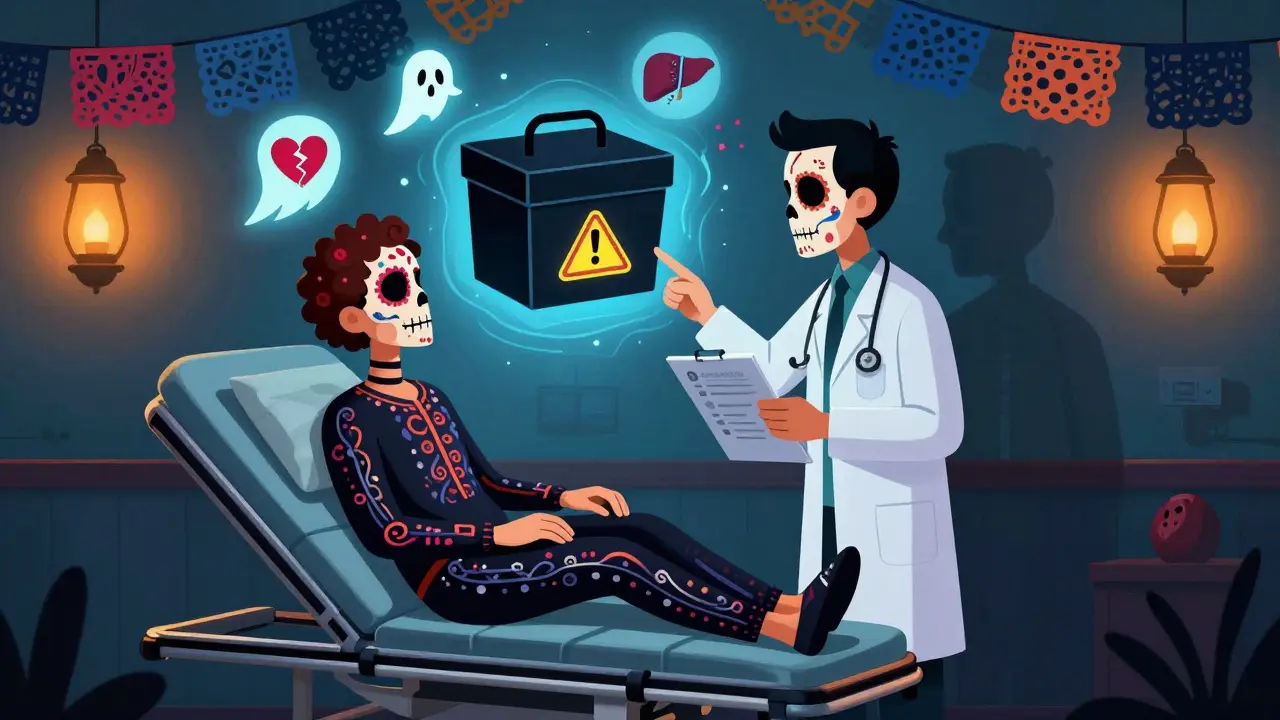
Doctors have to talk about it. They can’t just hand you the script. They need to explain why the drug is still being prescribed - and why the benefits might still outweigh the risks in your case. For someone with treatment-resistant depression, the risk of suicide without medication may be higher than the risk from the drug itself.
Pharmacies also have to act. Some drugs with black box warnings require special paperwork, patient counseling, or even prescriber certification. For example, isotretinoin (Accutane), used for severe acne, requires enrollment in a risk program that includes monthly pregnancy tests and counseling.
And sales drop. Studies show that after a black box warning, prescriptions for the drug often fall by 25% to 40%. But not always. If there are no alternatives - like for certain cancer drugs - doctors keep prescribing. The warning doesn’t mean stop. It means proceed with eyes wide open.
Real-World Impact: When Warnings Work - and When They Don’t
Take rosiglitazone again. After its 2007 black box warning, prescriptions dropped by 70%. But 3.8 million people still took it. Why? Because for some, it was the only drug that controlled their blood sugar.
Compare that to pioglitazone (Actos), which had similar heart risks but didn’t get the same media attention. Prescriptions didn’t drop as much. The warning alone doesn’t change behavior - awareness does.
That’s why patients need to ask questions:
- What’s the specific risk here?
- Have you seen this happen in other patients?
- What monitoring do I need?
- Are there safer alternatives?
Too often, patients don’t ask. A 2022 study found that nearly half of patients taking drugs with black box warnings had never discussed the warning with their doctor. That’s dangerous.
What Should You Do If Your Drug Has a Black Box Warning?
Don’t panic. Don’t stop cold. But don’t ignore it either.
Here’s what to do:
- Check the label. Read the black box warning. Don’t rely on your memory.
- Ask your doctor: "What part of this warning applies to me?" Some warnings only affect certain people - like those with liver disease or specific genes.
- Ask about monitoring. Do you need blood tests? How often? What signs should you watch for?
- Ask about alternatives. Is there another drug without the same risk? Even if it’s less effective, is it safer for you?
- Report side effects. Use the FDA’s MedWatch program. Your report helps others.
Some drugs with black box warnings are still the best option. For example, clozapine (Clozaril) has a warning for fatal low white blood cell counts - but it’s the only drug that works for some people with treatment-resistant schizophrenia. The risk is managed with weekly blood tests. That’s not a reason to avoid it. It’s a reason to manage it carefully.
What’s Next for Black Box Warnings?
The FDA is moving toward smarter warnings. Instead of one-size-fits-all alerts, they’re starting to use genetic data. For example, before prescribing abacavir (for HIV), doctors now test for the HLA-B*5701 gene. If you have it, the drug can cause a deadly allergic reaction. So they avoid it.
In the next few years, we’ll see more warnings tied to genetics, age, kidney function, or even drug interactions. The goal is to make warnings more precise - so only those at real risk get flagged.
Also, digital labels are coming. Soon, your pharmacist might show you a personalized warning based on your health history - not just what’s on the bottle.
Bottom Line: A Warning Isn’t a Stop Sign
A black box warning doesn’t mean "don’t take this." It means "take this with care."
Millions of people safely use drugs with black box warnings every day. The difference? They know the risk. They’re monitored. They talk to their doctor.
If your medication has this warning, you’re not alone. But you need to be informed. Don’t let fear stop you. Let knowledge guide you.