
Most people don’t think about their wrists until they start hurting. If you’ve woken up with numb fingers, felt a tingling shock when gripping your coffee cup, or struggled to button your shirt, you might be dealing with carpal tunnel syndrome. It’s not just a minor annoyance-it’s a real nerve problem that can slowly steal your hand function if left unchecked.
What Exactly Is Carpal Tunnel Syndrome?
Carpal tunnel syndrome happens when the median nerve gets squeezed inside a tight space in your wrist called the carpal tunnel. This tunnel is made of bones on the bottom and a tough ligament on top. Inside it, nine tendons bend your fingers, and the median nerve runs right alongside them. When swelling builds up-thanks to repetitive motion, injury, or even just aging-the nerve gets squished.
That’s when symptoms start. You’ll feel numbness, tingling, or burning in your thumb, index, middle, and half of your ring finger. The pain doesn’t stay in your hand. It can shoot up your forearm, even to your shoulder. And it’s often worse at night. Many people say they wake up shaking their hand like they’re trying to get rid of a static shock.
This isn’t just a theory. The Journal of Orthopaedic & Sports Physical Therapy confirmed in 2019 that this is the most common nerve compression issue in the upper body. About 10% of people in the U.S. will develop it. Women are three times more likely to get it than men, especially between ages 45 and 60.
How Does It Progress?
CTS doesn’t hit you all at once. It creeps in. There are three stages:
- Mild: Numbness comes and goes, mostly at night. You shake your hand and it’s fine. You might not even think it’s a problem yet.
- Moderate: Symptoms start during the day. Typing, driving, or holding a phone becomes uncomfortable. You’re not fully numb, but your grip feels weak. Your fingers don’t respond like they used to.
- Severe: The numbness doesn’t go away. You lose feeling in your fingers. Your thumb muscles start to waste away-you can’t pinch or grip things. Simple tasks like opening jars or turning a key become impossible.
Once you reach this stage, the damage can be permanent. The nerve’s protective coating (myelin) starts to break down. In extreme cases, the nerve fibers themselves die. That’s why early action matters.
How Do Doctors Diagnose It?
There’s no single test. Doctors use a mix of physical exams and tools. Here’s what they look for:
- Phalen’s Test: You hold your wrists bent forward for a minute. If your fingers tingle or go numb, it’s a sign.
- Tinel’s Sign: They tap over the median nerve. A shock-like feeling in your fingers means something’s wrong.
- Carpal Compression Test: Pressing directly on the carpal tunnel for 30 seconds. If symptoms appear, it’s a red flag.
- Katz Hand Diagram: You mark where you feel numbness on a drawing of a hand. The pattern tells them if it’s the median nerve.
- Electrodiagnostic Tests: Nerve conduction studies measure how fast signals travel. If the median nerve is slower than 3.7 milliseconds across the wrist, it’s confirmed.
But here’s the catch: not everyone with abnormal test results has symptoms. A 2022 study found that 15-20% of people over 60 show nerve damage on tests-even though they feel fine. That’s why doctors don’t rely on tests alone. They match the symptoms with the exam.
Conservative Treatments That Actually Work
If you’re in the mild or moderate stage, surgery isn’t your first step. In fact, most people get better without it.
Wrist Splints are the #1 recommended treatment. You wear them at night to keep your wrist straight. Studies show 60-70% of people see big improvement after 4-6 weeks. The key? Wear them every night, not just when it hurts. Position your wrist at 0-10 degrees of extension-not bent down. Custom splints cost $150-$250, but basic ones from the drugstore work too.
Nerve Gliding Exercises help the median nerve move more freely inside the tunnel. These aren’t just stretches. They’re specific movements designed to gently slide the nerve back and forth. Do them 2-3 times a day for 5-10 minutes. A physical therapist can show you the right way.
Corticosteroid Injections reduce swelling around the nerve. They give relief to about 70% of people-for 3 to 6 months. It’s not permanent, but it can buy you time to try other options. The cost? Around $300-$500 per shot.
Activity Changes matter more than you think. Avoid bending your wrist past 30 degrees for long periods. If you type all day, raise your keyboard so your wrists stay flat. If you work in manufacturing or healthcare, take micro-breaks every 20 minutes. Stretch your fingers, shake out your hands. Simple stuff, but it adds up.

When Surgery Becomes Necessary
If you’ve tried splints, exercises, and injections for 6-8 weeks and nothing’s helping-or if you’re losing muscle strength-you need to consider surgery.
There are two main types:
- Open Release: A 2-inch cut on the palm. The surgeon cuts the ligament to free the nerve. It’s been done for 90 years. Recovery takes 6-8 weeks.
- Endoscopic Release: One or two small cuts. A tiny camera guides the cut. Less scarring, faster healing. Recovery is about 2-3 weeks quicker.
Both have a 90-95% success rate. But complications happen. About 15-30% of people get “pillar pain”-tenderness on the sides of the palm. Scar tenderness affects 5-10%. Nerve injury is rare-under 1%.
There’s a newer option too: ultrasound-guided percutaneous release. The FDA approved the SX-One MicroKnife in 2021. It’s done through a needle-sized incision. Patients report 40% less pain and get back to work 50% faster. It’s not everywhere yet, but it’s growing.
Costs and Recovery
Conservative care (splint, therapy, injection) usually costs $450-$750 out of pocket. Surgery with insurance runs $1,200-$2,500. Endoscopic is 15-20% pricier than open, but you get back to work sooner.
After surgery, you’ll need 6-8 physical therapy sessions over 4-6 weeks. Most people return to light work in 2-3 weeks. If you do manual labor? Plan for 10-12 weeks. Don’t rush it. Lifting too soon can cause setbacks.
Real people report results. On RealSelf, 89% of patients said surgery was “worth it.” But 22% had lingering palm pain for months. On Reddit, people who used splints consistently for 8-12 weeks said their symptoms dropped by 60-80%.
Why Early Action Saves Your Hands
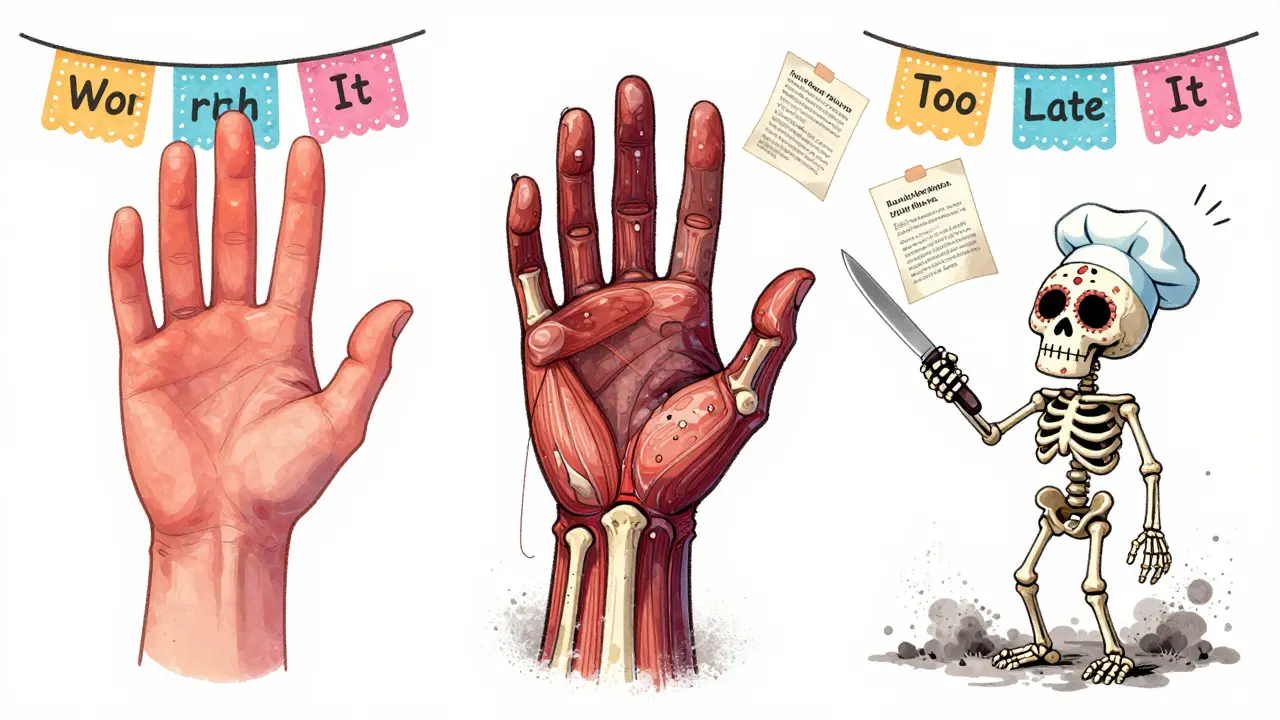
Here’s the hard truth: if your symptoms last longer than 12 months, conservative treatments only work about 35% of the time. If you catch it before 10 months? Success jumps to 75%.
A 2023 review in JAMA Neurology showed that people who got early splinting, nerve glides, and ergonomic changes were 45% less likely to need surgery within two years. That’s huge.
And it’s not just about pain. It’s about function. Losing grip strength affects your independence. Can’t open jars? Can’t hold your grandkid? Can’t type your job? That’s life-changing.
Who’s at Risk?
It’s not just office workers. The Bureau of Labor Statistics recorded 27,300 work-related CTS cases in 2022. Highest risk jobs:
- Manufacturing (23%)
- Healthcare (19%)
- Food service (14%)
Why? Repetitive motion. Holding tools. Bending wrists. No one tells you that stacking boxes or scrubbing dishes for hours can lead to this.
Even pregnancy can trigger it-fluid retention swells the tunnel. Most cases go away after delivery, but not always.
What Doesn’t Work
Yoga? Acupuncture? Magnets? No solid proof they help. Some people swear by them, but studies don’t back it up. Don’t waste money on gadgets that promise miracles.
And don’t wait for the pain to get worse. If your fingers are numb when you wake up, that’s your body telling you something’s wrong. Don’t ignore it.
What You Can Do Today
Stop scrolling. Stop typing. Do this now:
- Check your wrists. Are they bent while you’re using your phone or keyboard?
- Set a timer. Every 20 minutes, stretch your fingers wide, then make a fist. Repeat 5 times.
- Buy a basic wrist splint from the pharmacy. Wear it tonight.
- Call your doctor. Don’t wait until you can’t button your shirt.
CTS isn’t inevitable. It’s manageable-if you act early. Your hands are your tools. Don’t wait until they stop working.
Can carpal tunnel syndrome go away on its own?
Sometimes, yes-but only if it’s mild and caught early. Pregnancy-related CTS often resolves after birth. For most people, especially those with repetitive job tasks, symptoms won’t disappear without intervention. Waiting too long risks permanent nerve damage.
Are wrist splints really effective?
Yes, especially when worn consistently at night. Studies show 60-70% of people with mild to moderate carpal tunnel syndrome see significant improvement within 4-6 weeks. The key is keeping the wrist in a neutral position-not bent forward or backward.
How do I know if I need surgery?
If you’ve tried splinting, exercises, and steroid injections for 6-8 weeks with no improvement, or if you notice muscle wasting in your thumb (thenar atrophy), surgery is the next step. Permanent numbness or weakness means the nerve is already damaged-delaying surgery makes recovery harder.
Can typing cause carpal tunnel?
Typing alone doesn’t cause CTS, but it can make it worse. The real issue is repetitive wrist bending, forceful gripping, or poor ergonomics. If you type with your wrists bent down on a keyboard, you’re increasing pressure on the median nerve. Adjusting your setup helps.
Is carpal tunnel syndrome genetic?
It’s not directly inherited, but some people are born with smaller carpal tunnels, making them more prone to compression. If your family members have CTS, you may be at higher risk. Genetics play a role, but lifestyle and work habits are bigger factors.
What’s the difference between carpal tunnel and tendonitis?
Tendonitis is inflammation of the tendons-usually causes localized pain and swelling. Carpal tunnel affects the nerve, causing numbness, tingling, and weakness in specific fingers. Tendonitis hurts when you move; CTS feels weird even when you’re still.
Can I prevent carpal tunnel syndrome?
You can reduce your risk. Keep your wrists neutral while typing, take frequent breaks, stretch your hands and fingers, avoid forceful gripping, and maintain a healthy weight. If your job involves repetitive motion, ask your employer about ergonomic assessments.
If you’re reading this because your hand feels numb, don’t wait. The longer you wait, the harder it gets to fix. Start with a splint tonight. See your doctor this week. Your hands will thank you.