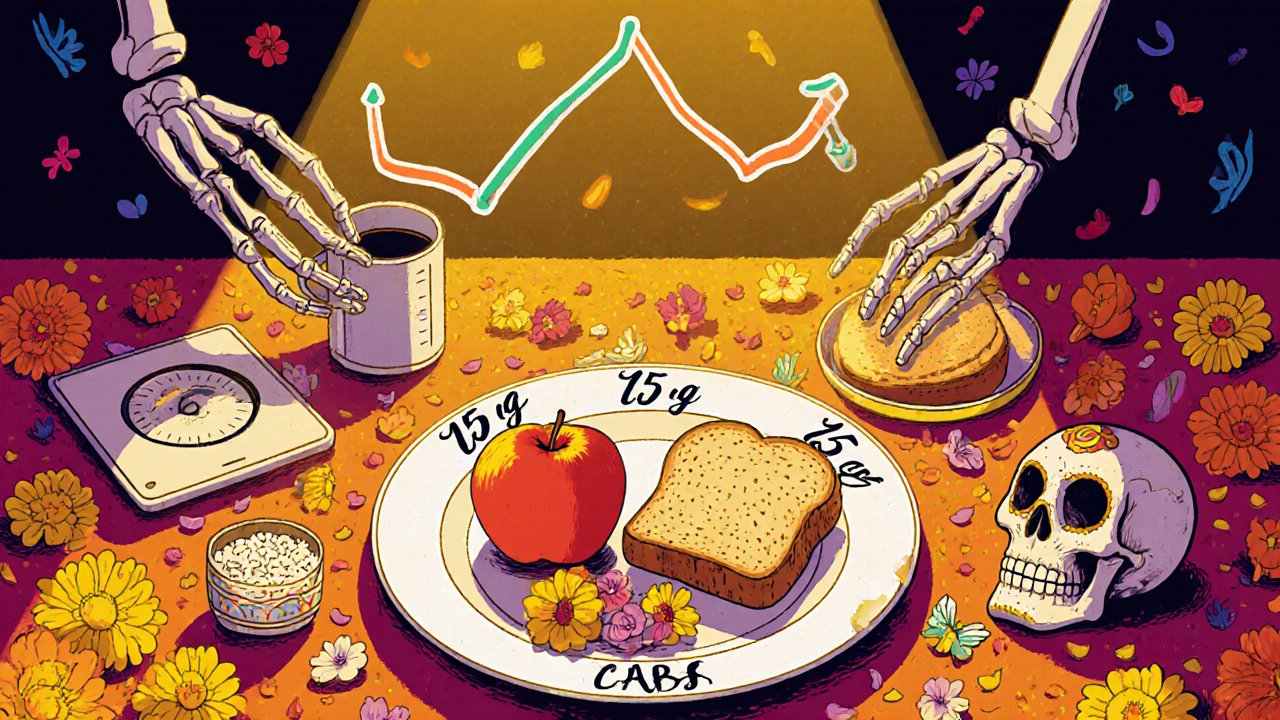
Managing diabetes isn’t about cutting out carbs entirely-it’s about knowing how much you’re eating and how it affects your blood sugar. That’s where carbohydrate counting comes in. It’s not magic. It’s math. And it works. If you’ve ever stared at a plate of pasta or a slice of pizza wondering how much insulin to take, carb counting gives you the answer. No guesswork. No fear. Just control.
Why Carbohydrate Counting Matters
Carbs are the main nutrient that raises your blood sugar. Every gram of carbohydrate turns into glucose after digestion. That’s why people with diabetes need to track them. Whether you have type 1 or type 2 diabetes and use insulin, knowing your carb intake lets you match your insulin dose to your food. This means fewer spikes and crashes. Fewer hospital visits. Better sleep. Better energy. The American Diabetes Association (ADA) recommends carb counting as a proven method to reach blood sugar goals. Studies show people who count carbs regularly lower their HbA1c by 0.5% to 1.0%-enough to reduce long-term complications like nerve damage, kidney problems, and vision loss. This isn’t theory. It’s real results from real people.How Carbs Are Measured
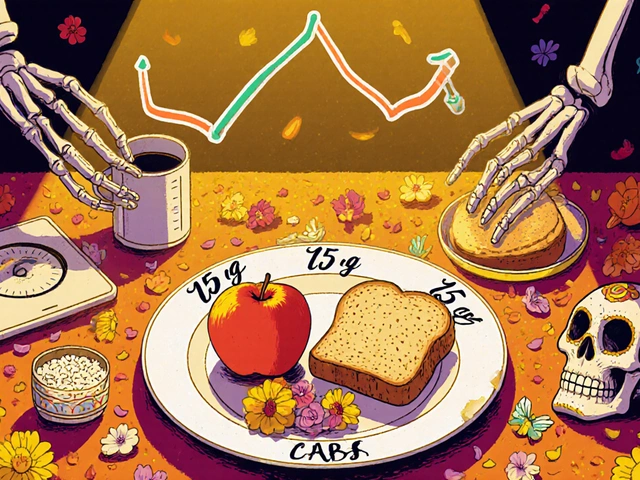
Carbs are measured in grams. One standard serving equals 15 grams of total carbohydrates. That’s not arbitrary-it’s based on how much that amount typically raises blood sugar in most people. Here’s what 15 grams of carbs looks like in real food:- 1 small apple (about 4 ounces)
- 1 slice of bread
- 1/2 cup of cooked rice or pasta
- 1/2 cup of beans or lentils
- 1 cup of milk
- 1/3 cup of oatmeal
Reading Nutrition Labels Like a Pro
Look at the nutrition facts panel. Find “Total Carbohydrate.” That number includes sugar, starch, and fiber. You don’t need to add anything up. The label already did it for you. But here’s the trick: fiber and sugar alcohols don’t raise blood sugar the same way as other carbs. If a food has more than 5 grams of fiber, subtract the full amount from total carbs. For sugar alcohols, divide the number by two and subtract that from total carbs. Example: A yogurt has 20 grams of total carbs, 6 grams of fiber, and 4 grams of sugar alcohols. 20 (total) - 6 (fiber) - 2 (half of sugar alcohols) = 12 net carbs. This adjustment matters. Skipping it can lead to over-dosing on insulin and low blood sugar.Carb-to-Insulin Ratio: The Key to Precision
If you take insulin, your doctor or diabetes educator will give you a carb-to-insulin ratio. This tells you how many units of insulin to take per gram of carbs. A common ratio is 1:10-meaning 1 unit of insulin covers 10 grams of carbs. But yours might be 1:8, 1:12, or even 1:15. It depends on your body, your insulin type, your activity level, and even the time of day. Let’s say you eat a sandwich with 45 grams of carbs and your ratio is 1:10. You’d take 4.5 units of insulin. Simple math. But you need to know your ratio first. Don’t guess. Ask your provider.Carb Counting vs. Other Methods
You might have heard of the plate method or glycemic index (GI). Here’s how carb counting compares:- Plate Method: Fill half your plate with non-starchy veggies, a quarter with protein, a quarter with carbs. Easy-but no numbers. You won’t know if you ate 30 or 70 grams of carbs.
- Glycemic Index: Ranks carbs by how fast they raise blood sugar. Useful, but doesn’t tell you how much you ate. A low-GI muffin can still have 50 grams of carbs.
- Carb Counting: Gives you exact numbers. You can eat anything-pizza, pasta, ice cream-as long as you know the carb count and adjust your insulin.

What You Need to Get Started
You don’t need fancy gear. Just a few tools:- A food scale (for accuracy)
- Measuring cups and spoons
- A calculator (or your phone)
- A food diary or app (like MyFitnessPal or Carb Manager)
Common Mistakes Beginners Make
Most people think they’re doing it right… until their blood sugar spikes anyway. Here are the top errors:- Forgetting hidden carbs: Milk in coffee, yogurt, sauces, starchy veggies like corn or peas. These add up fast. About 25% of daily carbs come from these sources.
- Guessing portions: A “small” apple might be 20 grams of carbs. A “large” one could be 30. Use a scale until you get good at estimating.
- Ignoring restaurant menus: Chain restaurants often list carb counts, but homemade dishes? You’re guessing. Call ahead or use apps like MyFitnessPal’s database.
- Not adjusting for insulin sensitivity: Your body might need more insulin at breakfast than dinner. Your ratio isn’t one-size-fits-all.
Real People, Real Results
One Reddit user shared: “My post-meal spikes dropped from 250+ to 160-180 in two weeks. I didn’t change my diet-I just started counting carbs.” Another person with type 1 diabetes lowered their HbA1c from 8.9% to 6.2% over 18 months using carb counting and consistent insulin dosing. That’s not luck. That’s discipline. But it’s not easy. A 2022 ADA survey found 63% of beginners spent 30-60 minutes per meal in the first month. That’s a lot. But after 30 days, accuracy jumps to 85%. The time investment pays off.When Carb Counting Isn’t Right for You
It’s not the only way. If you have type 2 diabetes and manage with diet and oral meds (like metformin), you might not need exact carb numbers. The plate method or portion control may be enough. But if you’re on insulin-especially rapid-acting insulin before meals-carb counting is the gold standard. It’s the most effective way to prevent highs and lows. The CDC, ADA, and NIDDK all agree.
What’s New in 2025
Technology is making carb counting easier than ever. Apps like Carb Manager now use AI to scan your food and estimate carbs with 85% accuracy. The USDA’s FoodData Central has over 300,000 entries updated quarterly. And continuous glucose monitors (CGMs) give you real-time feedback: “Did I count right?” The graph tells you. Even better, research from Harvard’s Joslin Diabetes Center shows future insulin pumps will auto-adjust doses based on carb intake and CGM data. We’re moving toward a future where you just eat-and the system handles the rest.Getting Support
You don’t have to figure this out alone. Ask your doctor for a referral to a Certified Diabetes Care and Education Specialist (CDCES). They’ll teach you how to read labels, calculate ratios, and troubleshoot highs and lows. Most diabetes education programs (92% of ADA-recognized ones) include carb counting. It’s not optional anymore-it’s standard care.Final Thought: Flexibility Is the Power
Carb counting doesn’t mean you can’t eat your favorite foods. It means you can enjoy pizza night, birthday cake, or sushi-without guilt or panic. You just need to know the carb count and adjust your insulin. That’s freedom. That’s control. That’s living well with diabetes.Do I need to count carbs if I have type 2 diabetes?
It depends. If you’re managing type 2 diabetes with diet and oral medications like metformin, you may not need exact carb counting. Simple portion control or the plate method can work well. But if you’ve started using insulin-especially mealtime insulin-carb counting becomes essential. It’s the only way to match your insulin dose to what you eat and avoid dangerous blood sugar swings.
Can I eat sugar if I count carbs?
Yes. Sugar is a carbohydrate, so it’s included in your carb count. A candy bar and a banana might both have 30 grams of carbs. The difference? The banana has fiber, vitamins, and takes longer to digest. But if you’re counting carbs, you can still have the candy bar-just make sure your insulin covers it. The goal isn’t to ban sugar-it’s to manage it.
How long does it take to get good at carb counting?
Most people see real improvement in accuracy after 30 days of consistent practice. The first week is the hardest-you’ll be measuring everything. By week 4, you’ll start estimating portions with 85% accuracy. After two months, you’ll know how many carbs are in your go-to meals without looking them up. It’s a skill, not a test. Practice makes perfect.
Do I need a food scale?
You don’t need one to start, but you’ll be more accurate with it. A food scale takes the guesswork out of portions. A cup of rice might be 45 grams of carbs-but if you scoop it loosely, it could be 60. That’s a big difference when you’re dosing insulin. Use a scale for the first 2-3 weeks. After that, you can estimate with confidence.
What if I eat out and can’t find the carb count?
Call the restaurant ahead of time-many chains post nutrition info online. Use apps like MyFitnessPal or Carb Manager, which have databases for popular dishes. If all else fails, estimate conservatively. If it’s a pasta dish, assume 60-70 grams of carbs. If it’s a burger with a bun, assume 40-45. It’s better to slightly overcount and take a little extra insulin than to undercount and risk a high.
Can carb counting help me lose weight?
Yes, indirectly. When you track carbs, you become more aware of what you’re eating. Many people naturally cut back on processed foods, sugary drinks, and refined grains-things that spike blood sugar and lead to hunger. Better blood sugar control also reduces cravings. So while carb counting isn’t a weight-loss diet, it often leads to healthier choices and steady weight management.