Statin Exercise Safety Calculator
Determine your safe exercise intensity level based on your unique risk factors. This calculator helps you exercise safely while taking statins.
Many people on statins worry that working out will hurt their muscles. They’ve heard stories - or felt it themselves - about soreness, stiffness, or even dark urine after a hard workout. The truth? You don’t have to quit exercise. In fact, staying active is one of the best things you can do while taking statins. But how you move matters. The goal isn’t to avoid exercise - it’s to do it smartly.
Why Statins and Exercise Can Cause Muscle Issues
Statins work by blocking an enzyme in your liver that makes cholesterol. But that same enzyme is also involved in making coenzyme Q10 (CoQ10), a compound your muscles need to produce energy. When CoQ10 drops, your muscle cells may struggle to recover after physical stress. This doesn’t mean every person on statins will have problems - far from it. But certain factors raise the risk: age over 65, intense workouts, low vitamin D, or taking other medications like fibrates. Research shows that while some people see higher levels of creatine kinase (CK) - a marker of muscle damage - after exercise, most don’t feel weaker or more tired. One 2023 study tracked 100 adults aged 55-73 who cycled at moderate intensity for 45 minutes. Statin users had slightly longer muscle relaxation times, but their strength didn’t drop. That’s key: biochemical changes don’t always mean real-world problems.The Exercise Intensity Divide
Not all workouts are created equal when you’re on statins. There’s a clear difference between moderate and vigorous activity. Moderate exercise - like brisk walking, cycling at a steady pace, or swimming - is safe for nearly everyone on statins. The 2023 study used 60% of VO2 max, which is about a 5 or 6 on a 10-point effort scale. People doing this kind of activity reported no worse muscle pain than those not taking statins. In fact, many felt better over time. Vigorous exercise - think sprinting, heavy weightlifting, or marathon training - is where risks creep up. A 2010 study of Boston Marathon runners found statin users had significantly higher CK levels after the race. Older athletes were especially vulnerable. That doesn’t mean you can’t run a marathon. But if you’re new to intense training or over 65, it’s smarter to build up slowly - or stick to moderate work for now.7 Proven Ways to Prevent Muscle Injury
- Keep it moderate. Aim for 150 minutes a week of activities like walking, cycling, or water aerobics. That’s 30 minutes, five days a week. Use the talk test: if you can speak in full sentences but not sing, you’re in the right zone.
- Start slow and build up. If you’re new to exercise or restarting after a break, increase your time or intensity by no more than 10% per week. A 2010 mouse study showed that animals trained gradually didn’t lose muscle strength even on statins. Humans likely respond the same way.
- Time your workouts. Take your statin at night, and exercise in the morning or early afternoon. Most statins peak in your bloodstream 2-4 hours after taking them. Exercising outside that window may lower the chance of interaction, even though direct proof is limited.
- Check your vitamin D. Low vitamin D is linked to higher muscle pain in statin users. Get your levels tested. If you’re under 30 ng/mL, your doctor may recommend a supplement. In Calgary, where sunlight is limited for months, this is especially important.
- Consider your statin type. Hydrophilic statins like pravastatin and rosuvastatin are less likely to enter muscle tissue than lipophilic ones like simvastatin and atorvastatin. If you’ve had muscle issues, ask your doctor if switching could help. One study found a 23% lower rate of muscle symptoms with hydrophilic statins during exercise.
- Avoid drug interactions. Never combine statins with fibrates (like gemfibrozil) unless absolutely necessary. This combo can raise your risk of rhabdomyolysis - a rare but serious muscle breakdown - by 3 to 5 times.
- Watch for warning signs. Normal muscle soreness fades in 1-2 days. If pain lasts longer than 72 hours, or you notice dark, tea-colored urine, stop exercising and call your doctor. These could be signs of rhabdomyolysis, which needs urgent care.

What the Experts Say
Dr. Neeltje Allard, who led the 2023 study, put it plainly: “Moderate exercise is safe for statin users. Skipping it does more harm than taking the medication.” Dr. Paul Thompson, a leading cardiologist, added: “The 25-35% drop in heart attacks from statins combined with the 20-30% drop from regular exercise creates a benefit you can’t ignore.” Meanwhile, Dr. Robert Rosenson warns that fear of muscle pain causes many people to quit statins - even when they need them. About 18.6% of users stop within the first year, often because they think exercise made things worse. But data shows that most muscle complaints aren’t caused by exercise itself - they’re worsened by inactivity.Real People, Real Results
Online forums like Reddit’s r/Statins are full of stories. One user, 68, switched from HIIT to daily walks and saw his muscle pain drop by 60%. Another, 72, started swimming three times a week after being told to “just rest.” Within months, her joint pain improved - and her cholesterol dropped another 12%. A survey of over 1,200 statin users found that 72% who stuck with moderate exercise reported better muscle tolerance after six months. That matches what we see in labs: muscles adapt. The more you move - safely - the better your body handles the statin.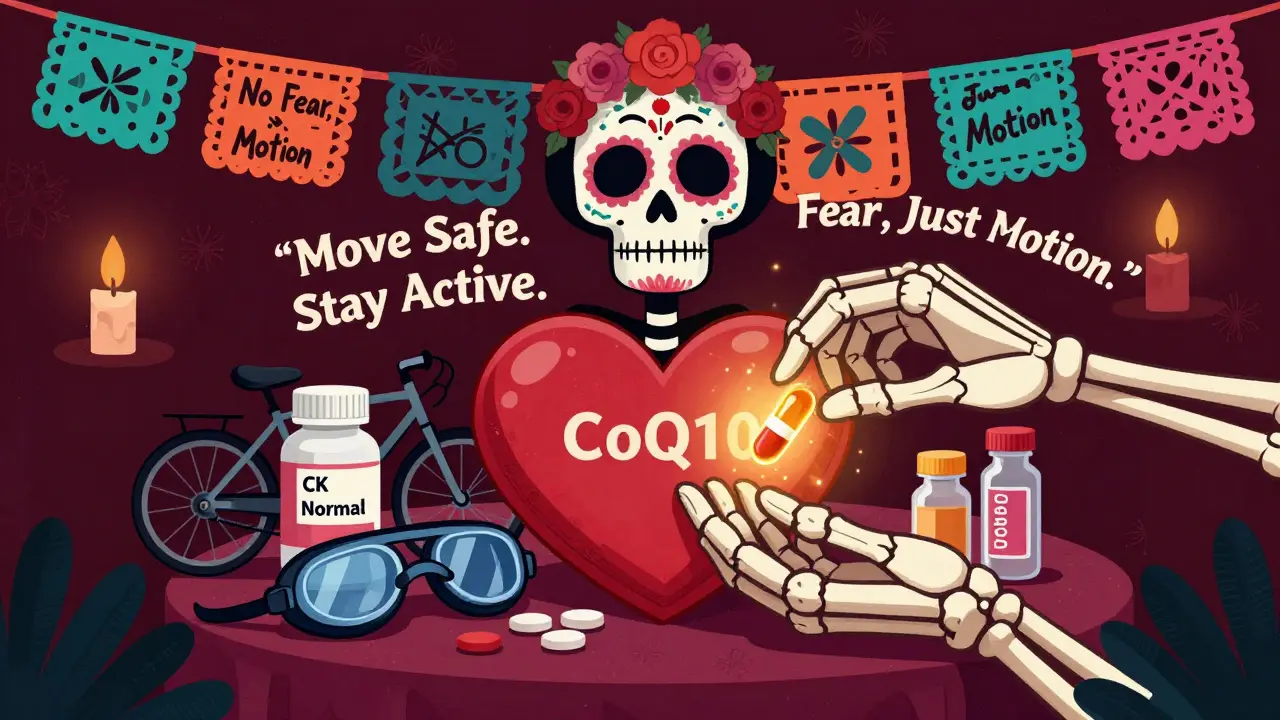
What to Do If You’re Already in Pain
If you’re already feeling sore after workouts:- Don’t stop moving - just scale back. Try walking instead of running. Use lighter weights.
- Track your symptoms. Note what you did, when you felt pain, and how long it lasted. Bring this to your doctor.
- Ask about a statin switch. Rosuvastatin or pravastatin might be gentler on your muscles.
- Get your vitamin D checked. It’s a simple blood test.
- Don’t take CoQ10 supplements unless your doctor says so. Studies on their effectiveness are mixed.
The Bigger Picture
Statins prevent heart attacks, strokes, and death. Exercise does the same - and adds better sleep, mood, balance, and independence as you age. The risk of serious muscle injury from statins plus exercise is extremely low - less than 1 in 10,000 people per year. The real danger isn’t the statin. It’s quitting both the pill and the workout because you’re afraid. You don’t need to be an athlete. You just need to move - consistently, safely, and without fear.Stick with what works. Walk. Swim. Bike. Lift light weights. Stretch. Your heart will thank you - and so will your muscles.
Can I still lift weights if I’m on statins?
Yes - but start light and go slow. Heavy lifting can raise creatine kinase levels, especially if you’re over 65 or new to strength training. Use moderate weights, do higher reps (12-15), and rest at least 48 hours between sessions. Avoid maxing out. If your muscles stay sore for more than 3 days, reduce the weight or take a break.
Does taking CoQ10 help with statin muscle pain?
Some people say it helps, but studies haven’t proven it consistently. The body makes CoQ10, and statins lower it - so the theory makes sense. But clinical trials show mixed results. If you want to try it, talk to your doctor first. Don’t replace proven strategies like moderate exercise or vitamin D with supplements.
Should I stop statins if my muscles hurt after exercise?
No - not without talking to your doctor. Muscle pain from statins is often mild and manageable. Stopping statins increases your risk of heart attack or stroke, especially if you’ve had one before. Instead, adjust your exercise, check your vitamin D, or ask about switching to a different statin. Most people can stay on statins and stay active.
Is it safe to run a marathon on statins?
It’s possible - but not recommended unless you’re already an experienced endurance athlete. Marathon running is extreme stress on the body. Statin users, especially older ones, have higher muscle injury markers after races. If you’re determined to run, train gradually, stay hydrated, and get your CK checked after the race. Talk to your cardiologist first.
How do I know if my muscle pain is from statins or just exercise?
Exercise soreness usually peaks 24-48 hours after a workout and fades within 72 hours. Statin-related pain often feels deeper, more constant, and may show up even on rest days. It’s also more common in the shoulders, thighs, or calves. If pain lasts longer than 3 days, happens without recent exercise, or comes with dark urine, get checked. A simple blood test for CK can help tell the difference.
Can I take statins every other day to reduce side effects?
For some people, yes - but only under medical supervision. Studies show that rosuvastatin 10 mg every other day can lower cholesterol almost as well as daily dosing, with fewer muscle complaints. This isn’t true for all statins. Never change your dose without talking to your doctor. Your heart health depends on consistent cholesterol control.