Every year, over 10,000 parents in the U.S. call poison control centers because they gave their child the wrong amount of medicine. Not because they didn’t care. Not because they were careless. But because they used a household spoon to measure liquid medication.
It sounds harmless. You’ve got a teaspoon in your drawer. You’ve used it for sugar, salt, and coffee. Why not for medicine? The truth is, that spoon isn’t a medical tool. It’s a kitchen tool. And in medicine, that difference can be life-or-death.
Why Household Spoons Are Dangerous for Kids’ Medicine
A standard medical teaspoon holds exactly 5 milliliters (mL). Sounds simple, right? But your kitchen teaspoon? It might hold 3 mL. Or 7 mL. Or anything in between. Studies show household teaspoons vary by up to 40% in size. That means if your child’s dose is 5 mL, and you use a spoon that holds only 3 mL, you’re giving them 40% less medicine. The infection won’t clear. If your spoon holds 7 mL, you’re giving 40% too much. That could cause drowsiness, vomiting, or worse.
And it’s not just teaspoons. A tablespoon? That’s three times bigger than a teaspoon. If you accidentally grab the wrong spoon, you’re giving your child three times the dose they need. That’s not a mistake-it’s a medical emergency waiting to happen.
Research from the National Institutes of Health found that nearly 40% of parents made dosing errors when using household spoons. Over 41% couldn’t measure the correct amount even when they thought they were being careful. And this isn’t rare. About 75% of American families still use kitchen spoons to give liquid medicine. That’s three out of four households. Every day.
What You Should Use Instead
The fix is simple: use only the tool that comes with the medicine. That’s usually one of two things: an oral syringe or a dosing cup.
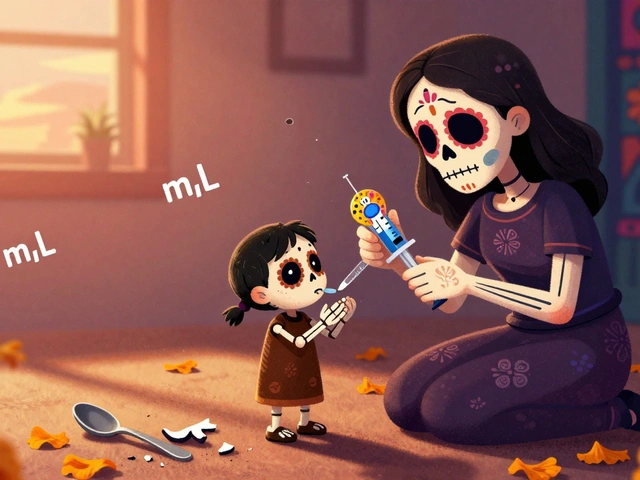
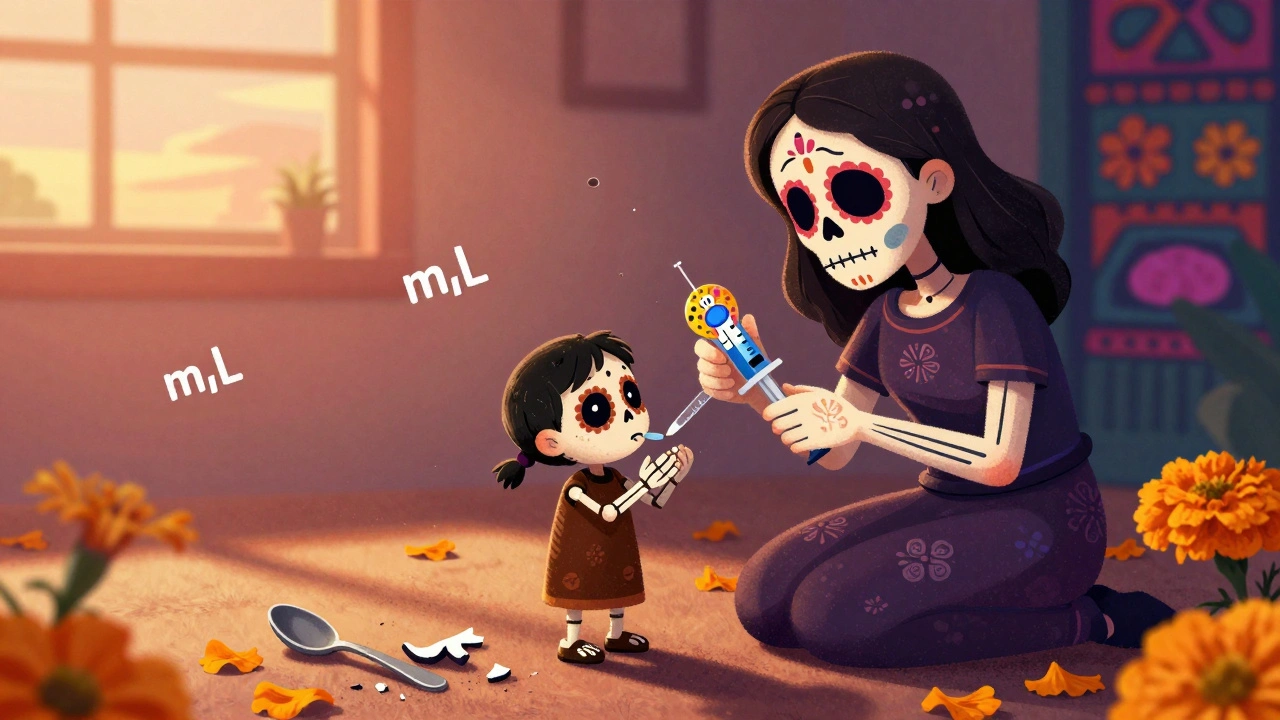
Oral syringes are the gold standard. They’re marked in milliliters (mL), often down to 0.1 mL increments. That means you can give 3.5 mL exactly. No guessing. No estimating. Just line up the plunger with the right number. They’re especially critical for doses under 5 mL-like newborn or infant doses. Many parents think droppers are fine, but syringes are more accurate and easier to control. You can gently squirt the medicine between your child’s cheek and gums, avoiding choking risks.
Dosing cups are okay too-if they’re the one that came with the medicine. But they’re less precise. Most cups only have markings at 5 mL, 10 mL, 15 mL. So if the dose is 2.5 mL or 7 mL? You’re estimating. And estimating with medicine is risky.
Never use a regular kitchen spoon, a shot glass, a regular cup, or a dessert spoon. Even if it’s labeled “teaspoon” on the bottle. That’s not a promise-it’s a trap.
Why Labels Say “mL” Now (Not “tsp”)
Pharmacies and drug makers are slowly changing labels. You’ll see “5 mL” instead of “1 teaspoon.” That’s not just a trend-it’s a safety rule backed by the FDA, CDC, and American Academy of Pediatrics.
A 2016 study showed something shocking: when labels said “teaspoon,” one-third of parents thought it was okay to use a kitchen spoon. When labels said “mL,” less than 10% did. That’s a 23-point drop in dangerous behavior just by changing the wording.
Even spelling out “teaspoon” made it worse than using the abbreviation “tsp.” Why? Because “teaspoon” sounds familiar. It feels normal. “mL” feels clinical. And that’s the point. You need to feel like you’re doing something medical-not cooking.
How to Measure Correctly Every Time
Here’s the exact routine you should follow every single time you give liquid medicine to a child:
- Check the label. Is the dose in mL? If not, ask the pharmacist to rewrite it.
- Use only the device that came with the medicine. If you lost it, call your pharmacy. They’ll give you a new oral syringe for free.
- Hold the syringe or cup at eye level. Don’t look down. Don’t guess. Look straight at the line.
- Don’t use the cap or any other container. Only the tool designed for that medicine.
- Administer slowly. Gently squirt the medicine between the cheek and tongue-not straight down the throat. This reduces choking and gagging.
- Write down the time and dose in a notebook or phone. Especially if you’re giving medicine multiple times a day.
And if you’re ever unsure? Call your pharmacist. They’re trained for this. They’ve seen the mistakes. They’ll walk you through it-even if it’s 8 p.m. on a Sunday.
What Happens When You Get It Wrong
Underdosing means the medicine doesn’t work. A fever stays. An ear infection spreads. A bacterial infection lingers. That’s bad enough.
Overdosing? That’s worse. Too much acetaminophen can damage the liver. Too much ibuprofen can cause stomach bleeding. Too much cough syrup? That can lead to seizures or breathing problems. Children’s bodies are small. Their systems are still developing. They don’t handle extra medicine like adults do.
One study found that 80% of all pediatric medication errors at home involve liquid medicines. That’s not a coincidence. It’s a system failure. And it’s fixable.

What’s Changing in the Industry
Health systems are waking up. Pharmacies like Aspirus now give every parent an oral syringe with every pediatric liquid prescription. No exceptions. No excuses.
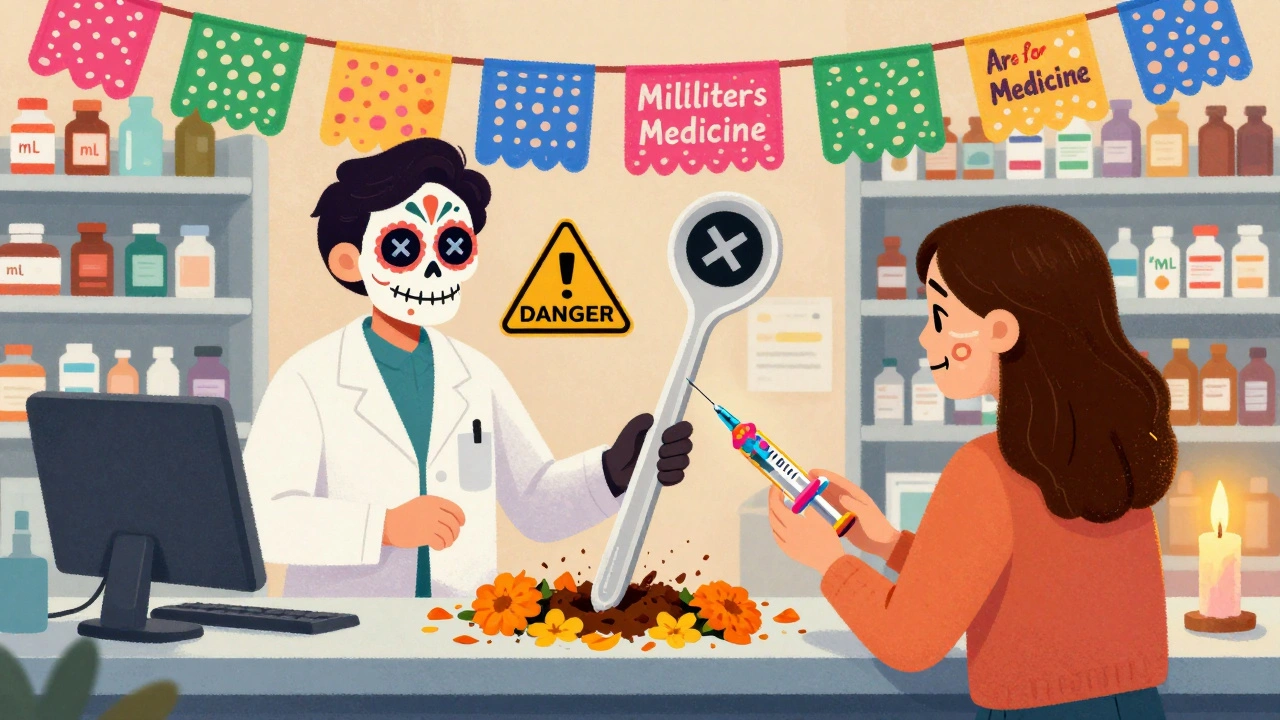
The CDC’s “Spoons Are for Soup” campaign is running across hospitals, clinics, and pharmacies. Posters, handouts, videos-all reminding parents: Milliliters are for medicine. Spoons are for soup.
The FDA is pushing for mandatory milliliter-only labeling on all pediatric liquid medications. That’s coming soon. But you don’t need to wait. Start now.
Final Reminder: This Isn’t Optional
You wouldn’t use a kitchen measuring cup to give insulin to a diabetic child. You wouldn’t use a coffee spoon to give antibiotics to a toddler. So why use a teaspoon for anything else?
Medicine isn’t sugar. It’s not a flavoring. It’s a powerful substance. And it needs precision. Your child’s life depends on it.
Keep the oral syringe in the same place every time-next to the medicine. Wash it after each use. Reuse it. Don’t throw it away. And if someone else is giving the medicine-your partner, grandma, babysitter-show them how to use it. Don’t assume they know.
One simple tool. One simple rule. No more spoons.
Can I use a kitchen teaspoon if I don’t have a syringe?
No. Kitchen teaspoons vary in size and are not accurate for medicine. If you don’t have a syringe or dosing cup, call your pharmacy. They’ll give you one for free. Never guess the dose.
Why do some medicine bottles still say “teaspoon”?
Some older labels still use “teaspoon,” but that’s outdated. The FDA and AAP now require milliliter-only labeling. If your bottle says “tsp,” ask your pharmacist to clarify the dose in mL. Don’t rely on the label alone.
Are droppers better than syringes?
Droppers are better than spoons, but not as good as syringes. Syringes let you measure down to 0.1 mL and give you more control. Droppers can drip or spill, and it’s harder to read the exact amount. Use a syringe whenever possible.
What if my child spits out the medicine?
Don’t give another full dose. Wait until the next scheduled time. Giving extra medicine can lead to overdose. If your child throws up within 15 minutes of taking it, call your doctor. Otherwise, wait.
Can I use a regular measuring cup from the kitchen?
No. Kitchen measuring cups are for cooking, not medicine. They’re not calibrated for small doses. Even a 1/4 cup is way too big. Always use the tool provided with the medicine-oral syringe or dosing cup.
Is it safe to mix medicine with juice or food?
Only if your pharmacist says yes. Some medicines lose effectiveness when mixed. Others can taste worse. Always ask first. If you do mix it, make sure your child drinks all of it-don’t leave any behind.