When you pick up a prescription, you might not think about whether the pill in your bottle is the brand name or a generic version. But behind the scenes, a complex web of state laws decides whether your pharmacist can swap one for the other. These rules aren’t the same everywhere. In one state, your pharmacist might be required to substitute a cheaper generic unless you say no. In another, they can’t switch anything without your written consent. And if your drug is a biologic-like an insulin or rheumatoid arthritis treatment-the rules get even more complicated. This isn’t just paperwork. It affects your out-of-pocket cost, your safety, and how much time your pharmacist spends just trying to follow the law.
How Generic Substitution Works (and Why It Matters)
Generic drugs are chemically identical to brand-name drugs. They have the same active ingredient, dosage, strength, and route of administration. The FDA requires them to meet the same quality and effectiveness standards. But they cost far less-often 80% to 85% cheaper. That’s why the federal government pushed for generic substitution back in the 1980s with the Hatch-Waxman Act. The goal? Save money without sacrificing care.
Today, generics make up 90.2% of all prescriptions filled in the U.S., but they only account for 18% of total drug spending. That’s over $356 billion saved in 2023 alone. The savings come from substitution: when a pharmacist gives you a generic instead of the brand-name drug your doctor wrote on the prescription. But whether they can do that-and whether they have to-depends entirely on the state you’re in.
Mandatory vs. Permissive Laws: The Big Divide
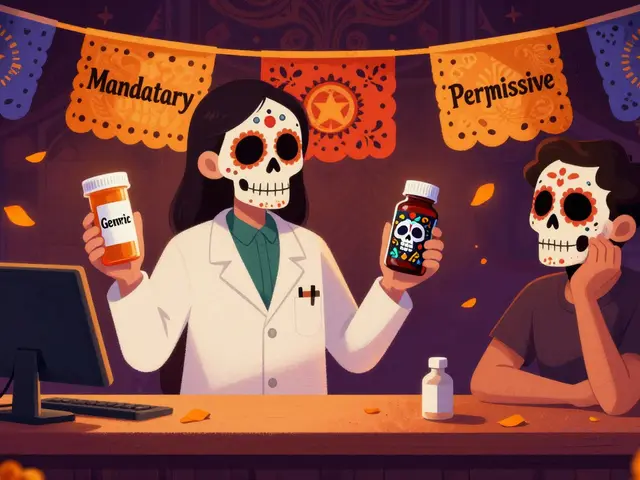
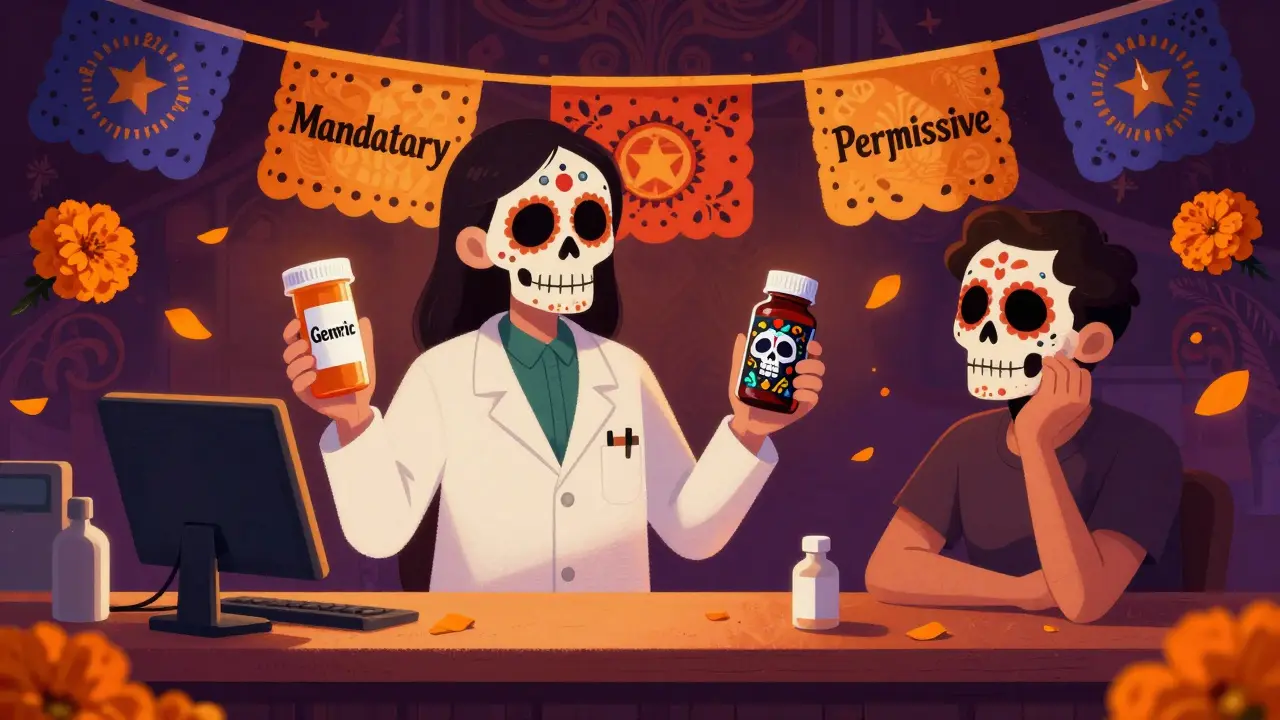
There are two main types of state laws governing substitution: mandatory and permissive.
**Mandatory substitution** means the pharmacist must substitute a generic drug unless the prescriber writes "dispense as written" or the patient refuses. Nineteen states have this rule. In these places, the default is substitution. You have to actively say no to get the brand name.
**Permissive substitution** means the pharmacist can substitute, but isn’t required to. Thirty-one states plus Washington, D.C., follow this model. Here, substitution only happens if the pharmacist chooses to do it-and if the patient agrees. In some cases, the pharmacist might not even mention it.
The difference isn’t just theoretical. States with mandatory substitution see 8.7% higher generic utilization rates. That translates to $55 less per person per year in drug costs, according to CMS data. But it also creates friction. Pharmacists in mandatory states report fewer patient complaints about cost-but more confusion about why they’re getting a different pill.
Who Gets to Say No? Patient Consent and Notification
Even in permissive states, pharmacists often need to inform you before swapping drugs. But how they do it-and whether they even have to-varies wildly.
Only seven states plus D.C. require explicit patient consent before substitution. That means the pharmacist must ask you directly-verbally or in writing-and get your okay. In those places, 68% of patients say they feel more informed about their medications, according to a 2023 University of Michigan poll.
But in 20 states, there’s no requirement to notify you at all. The substitution happens silently. You open your bottle, see a different name, and assume your doctor changed the prescription. That’s not just misleading-it’s risky. A 2021 study from the Institute for Safe Medication Practices found that 22% of substitution-related medication errors occurred in states without notification rules.
Some states walk a middle path. For example, New York requires pharmacists to offer substitution and document the patient’s response. California mandates electronic notification to the prescriber-but not necessarily to the patient. And Oklahoma? You need written authorization from either the prescriber or the payer before any substitution can happen. That’s one of the strictest rules in the country.
Liability: Who Gets Blamed if Something Goes Wrong?
Here’s a hidden issue most patients never think about: Who is legally responsible if a substitution causes harm?
Twenty-four states offer no explicit legal protection to pharmacists who substitute generics. That means if you have an adverse reaction-say, a rash or a drop in blood pressure-and it’s traced back to the generic drug, the pharmacist could be sued. No matter how carefully they followed FDA guidelines.
That’s why some pharmacists refuse to substitute even when it’s safe. Sarah Jennings, a pharmacist in Connecticut, told Pharmacy Times in February 2024 that she avoids substituting high-risk drugs like warfarin because she has no liability protection. "I’d rather lose a sale than risk a lawsuit," she said.
Meanwhile, 26 states have laws that shield pharmacists from liability if they follow substitution rules. These protections aren’t just legal safety nets-they affect how pharmacists make decisions. In states without them, substitution rates are lower, even for safe, well-established generics.
The Biologic Wild West: Where Rules Get Even Messier
Biosimilars are the generic version of biologic drugs-medications made from living cells, like Humira, Enbrel, or insulin glargine. Unlike small-molecule generics, biosimilars aren’t exact copies. They’re "similar enough" to be approved by the FDA. But that’s where the federal rules end.
Forty-five states (including D.C.) have special laws for biosimilar substitution. Most require the pharmacist to notify the prescriber within 5 to 30 days. California requires electronic notification within 5 days. Texas requires both patient and prescriber notification. In some states, the pharmacist must get prescriber approval before substituting at all.
And here’s the kicker: 48 states allow prescribers to block substitution entirely by writing "dispense as written" on the prescription. That’s more than the number of states that require patient consent. The result? Biosimilars make up only 14.3% of eligible prescriptions, even though the FDA has approved 32 of them. Compare that to small-molecule generics, which are used in over 90% of cases.
"The regulatory patchwork is the biggest barrier to biosimilar adoption," said FDA Commissioner Robert Califf in February 2024. "Patients are missing out on lower-cost options because pharmacists can’t keep up with 51 different sets of rules."
What Pharmacists Really Deal With Every Day
Imagine you’re a pharmacist working in a chain that spans five states. You fill a prescription for metformin in Ohio. Then you switch to a telepharmacy role serving patients in Georgia. Later, you help a patient in Pennsylvania who’s on a biologic for psoriasis. Each state has different rules.
You check the Orange Book for therapeutic equivalence. You check your pharmacy’s EHR system. You check state law summaries. You check whether the patient has consented. You check whether the prescriber blocked substitution. You check whether the payer allows it.
On average, pharmacists spend 8.2 hours per month just navigating these rules. New pharmacists need 4 to 6 weeks of training before they can confidently handle substitutions across multiple states. And even then, mistakes happen. A 2023 survey found 41% of pharmacists had made at least one substitution-related error in the past year.
Independent pharmacies are hit hardest. They’re 68% more likely than chain pharmacies to report substitution errors. Why? They don’t have dedicated compliance teams or real-time software updates. Chain pharmacies spend an average of $1.2 million per state annually just to stay compliant. Multiply that by 51 jurisdictions, and you’re looking at $61.2 million a year.
Technology Is Helping-But Not Everywhere
Some tools are making life easier. The ScriptPro SP 200 system now updates state substitution rules in real time. In a 12-state trial, it cut regulatory errors by 37%. California’s electronic prescriber notification system reduced substitution errors by 32% after its 2022 rollout.
But only 28 states have fully integrated substitution protocols into major electronic health record systems like Epic or Cerner. In the other 23, pharmacists still manually check paper forms, call prescribers, or rely on outdated printed guides.
The National Association of Boards of Pharmacy offers a free online resource that maps all state rules. But 53% of pharmacists say it lacks detail for complex biologic cases. And it doesn’t replace real-time system updates.
The Push for Change: Are We Heading Toward National Standards?
There’s growing pressure to simplify this mess. The National Association of Boards of Pharmacy launched the Model State Pharmacy Act Revision Project in January 2024. It aims to cut the 51 different state systems down to just three regional models by 2026-2027.
Meanwhile, 17 states introduced substitution law reforms in 2023-2024. Nine of them-Texas, Illinois, Pennsylvania, and others-passed laws to align biologic and small-molecule substitution rules. The Congressional Budget Office estimates that harmonized laws could save $14.3 billion over ten years.
But change is slow. Seventy-two percent of pharmacy leaders support federal preemption-meaning the federal government would override state laws and create one national standard. But that’s politically risky. Pharmacy practice has always been a state-regulated profession. Congress hasn’t moved on it.
For now, the system stays fragmented. And that means if you’re on a biologic, live in a state without patient notification, or work in a pharmacy that can’t afford compliance software-you’re caught in the middle.
What You Should Do
- If you’re prescribed a brand-name drug and want to save money, ask your pharmacist: "Can you substitute a generic?" Don’t assume it’s automatic.
- If you’re switched to a generic or biosimilar, ask whether your prescriber was notified. In some states, they’re required to know.
- Check your prescription bottle. If the name changed and you weren’t told, ask why.
- If you’re on a high-risk drug (like warfarin, levothyroxine, or insulin), insist on being informed before any substitution.
- Use tools like the NABP’s online database to check your state’s rules if you travel or use telepharmacy services.
Can my pharmacist substitute my brand-name drug without telling me?
In 20 states and Washington, D.C., pharmacists are not required to notify you before substituting a generic drug. That means you might get a different pill without knowing it. In 31 states plus D.C., they must offer substitution and document your response. In 7 states plus D.C., they must get your explicit consent before making the switch. Always check your prescription label and ask if you’re unsure.
Are generic drugs as safe and effective as brand-name drugs?
Yes. The FDA requires generic drugs to have the same active ingredient, strength, dosage form, and route of administration as the brand-name version. They must also meet the same strict standards for quality, purity, and performance. Bioequivalence studies prove they work the same way in the body. The only differences are in inactive ingredients, like fillers or dyes-which rarely affect safety or effectiveness.
Why are biosimilar substitution rules so different from generic rules?
Biosimilars are made from living cells, not chemicals, so they can’t be exact copies like small-molecule generics. The FDA approves them based on "similarity," not identity. Because of this, states have imposed stricter rules: 45 states require prescriber notification, 38 require patient notification, and 48 allow prescribers to block substitution entirely. These rules exist because of concerns about immune reactions, tracking adverse events, and long-term safety-though there’s no evidence that biosimilars are less safe than their reference products.
What does "dispense as written" mean on a prescription?
"Dispense as written" (DAW) is a code or note written by the prescriber that tells the pharmacist not to substitute the brand-name drug with a generic or biosimilar. It overrides any state substitution law. If you see this on your prescription, you’ll get the brand-name drug-even if a cheaper generic is available. Some prescribers use it out of habit, fear of side effects, or lack of awareness about generics. You can always ask if substitution is possible.
Do I have a right to know if my drug was switched?
You have a right to be informed, but not every state guarantees it. In 7 states plus D.C., pharmacists must get your explicit consent before substituting. In 31 states plus D.C., they must offer substitution and record your response. But in 20 states, they can substitute without telling you at all. Always check your pill bottle, ask your pharmacist, and request documentation if you’re concerned about changes to your medication.