
Imagine breaking out in hundreds of tiny, itchy bumps just after jogging, eating spicy food, or even walking into a warm room. For people with cholinergic urticaria, this isn’t rare-it’s everyday life. Unlike regular hives triggered by allergens like peanuts or pollen, cholinergic urticaria (CU) is caused by your own body heat. When your core temperature rises just half a degree, your immune system overreacts, flooding your skin with histamine and turning harmless sweating into a painful, embarrassing flare-up.
What Exactly Is Cholinergic Urticaria?
Cholinergic urticaria is a type of physical urticaria-meaning it’s triggered by a physical stimulus, not an allergen. The trigger? Anything that raises your body temperature enough to make you sweat. That includes exercise, hot showers, spicy meals, stress, or even wearing heavy clothing on a mild day. The reaction isn’t to sweat itself, but to the nerve signals that tell your sweat glands to activate. In people with CU, those nerves accidentally sound an alarm to your immune system.
The result? Tiny red bumps, usually 1-3 millimeters wide, surrounded by red flares. They show up fast-within 2 to 15 minutes of heating up-and feel like needles under your skin. Most people describe them as itchy, tingling, and burning. They typically appear on the chest (78% of cases), face (65%), upper back (62%), and arms (58%). You rarely see them on your palms, soles, or inside your mouth.
These hives don’t last long. Most fade within 15 to 30 minutes after you cool down, and almost always disappear completely within 90 minutes. But the cycle repeats every time your temperature climbs again. For many, it’s a daily battle.
Why Does This Happen? The Science Behind the Bumps
It’s not just bad luck. Research shows CU is tied to specific biological changes. People with this condition have lower levels of acetylcholinesterase (AchE) and the cholinergic receptor CHRM3 in their sweat glands. These proteins normally help calm down nerve signals after sweating. When they’re missing, the signal keeps firing-and your immune system thinks it’s under attack.
That triggers mast cells to release histamine and other inflammatory chemicals. At the same time, your skin starts producing chemokines like CCL2, CCL5, and CCL17, which pull in immune cells that make the redness and swelling worse. It’s a perfect storm of nerve misfires and immune overreaction.
What makes CU unique is how predictable it is. Unlike cold urticaria (which flares in freezing temperatures) or solar urticaria (triggered by UV light), CU only happens when you’re warm enough to sweat. Even a light workout indoors can set it off. That’s why so many people with CU avoid exercise-not because they’re lazy, but because their body literally rebels against movement.
Who Gets Cholinergic Urticaria?
It usually starts in teens or early twenties. Most people first notice symptoms between ages 15 and 25. It’s rare in children under 10 and uncommon after 40, though it can persist for years. About 5-7% of all people with hives have this form. Globally, it affects roughly 0.04-0.07% of the population-about 3 to 5 million people.
It’s more common in warmer climates. Studies show higher rates in Southeast Asia than in Scandinavia. But even in cold places like Calgary, CU flares up indoors during winter when heaters are on full blast or after a hot yoga class.
Interestingly, about 30% of people with CU see their symptoms fade naturally within 7 to 10 years. But for the rest, it’s a chronic condition that requires active management.
How Is It Diagnosed?
Doctors don’t rely on blood tests or skin prick tests for CU. The gold standard is the passive warming test. You sit in a warm room (around 39°C or 102°F) while your core temperature is monitored. If your body heats up by just 0.5°C and you develop the classic pinpoint hives within 15 minutes, the diagnosis is confirmed. This test works in 94% of true cases.
Many people are misdiagnosed. In fact, nearly 1 in 5 people who go to the ER with CU symptoms are told they’re having exercise-induced anaphylaxis. That’s dangerous-because the treatments are completely different. CU isn’t usually life-threatening, but it can be. About 12% of patients report symptoms like dizziness, fast heartbeat, or trouble breathing. Around 9% are prescribed an epinephrine auto-injector just in case.
What Triggers It? Beyond Just Exercise
Exercise is the #1 trigger-reported by 9 in 10 people with CU. But it’s not the only one:
- Spicy foods - Capsaicin in chili peppers raises body temperature and triggers sweating. Around 67% of CU patients report flare-ups after eating hot food.
- Hot showers or baths - Even a 10-minute hot shower can be enough to start a flare.
- Stress or strong emotions - Anxiety, excitement, or anger can trigger the same nerve response as physical heat.
- Wearing tight or non-breathable clothing - Synthetic fabrics trap heat and sweat, creating a microclimate on your skin.
- Warm environments - A crowded room, a car in the sun, or even a heated office can be enough.
One patient on Reddit described breaking out after just walking from her car to her office on a 15°C day. Her coat was too thick. That’s how sensitive this condition can be.
How to Prevent Flare-Ups: Practical, Real-World Strategies
You can’t avoid heat forever. But you can control how your body responds to it. Here’s what actually works, based on patient reports and clinical guidelines:
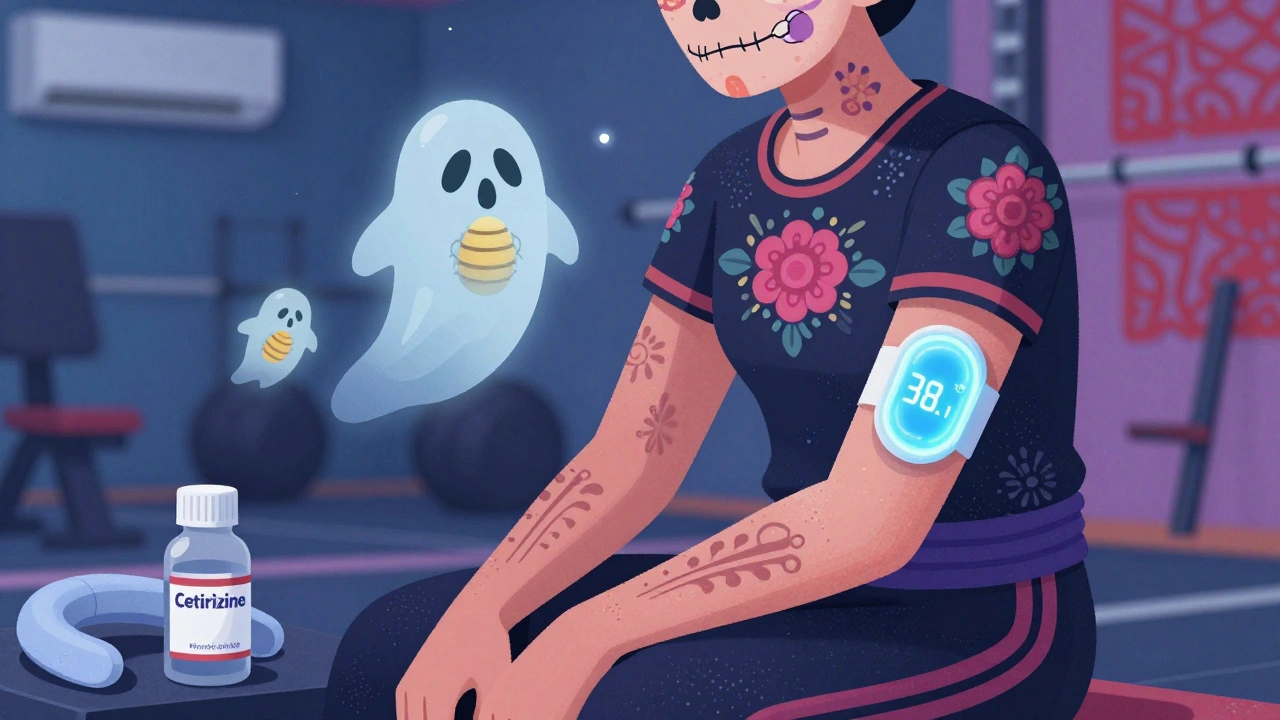
- Wear moisture-wicking clothing - Look for fabrics like polyester blends or merino wool. Avoid cotton-it soaks up sweat and holds heat against your skin. Many CU patients swear by athletic wear designed for hot yoga or running.
- Exercise in cool environments - Work out in air-conditioned gyms, early in the morning, or use a fan. Some people switch to swimming or water aerobics-water keeps body temperature stable.
- Use cooling tools - Keep a damp towel, portable fan, or cooling neck wrap handy. A quick spray of cold water on your neck or wrists can stop a flare before it starts.
- Manage your meals - Avoid spicy foods, alcohol, and hot drinks before activity. If you eat spicy food, wait at least 2 hours before exercising.
- Lower your personal trigger point - Most people with CU have a core temperature threshold around 38.1°C (100.6°F). Use a wearable thermometer (like ingestible pills or smart patches) to track your temperature during activity. Once you know your limit, stop before you hit it.
- Take antihistamines before activity - This is the most effective prevention method. Non-sedating options like cetirizine (10-20 mg) or loratadine (10 mg) taken 1-2 hours before exercise reduce flare-ups in 68% of patients. Some need up to 40 mg daily for full control.
One woman in the Urticaria Center’s patient registry said switching to air-conditioned workouts and moisture-wicking gear cut her flare-ups from daily to just 1-2 times a month. That’s life-changing.
Treatment Options: What Works and What Doesn’t
There’s no cure for cholinergic urticaria-but there are effective ways to manage it.
- Second-generation antihistamines - Cetirizine, loratadine, fexofenadine. These are first-line. They block histamine without causing drowsiness. Doses can be increased up to 4 times the normal amount if needed.
- H2 blockers - Famotidine (Pepcid) 20 mg twice daily. Used in combination with antihistamines, this helps 57% of patients who don’t respond to antihistamines alone.
- Omalizumab (Xolair) - A biologic injection originally for asthma and chronic hives. Approved for severe CU in Europe in 2023. It reduced symptoms by 78% in clinical trials. But it costs about $3,500 per month in the U.S.-out of reach for most.
- Other options - Some doctors try leukotriene inhibitors (like montelukast) or phototherapy, but evidence is weak.
First-generation antihistamines like diphenhydramine (Benadryl) are avoided-they cause drowsiness, which interferes with work, driving, and daily life. A 2022 survey found 58% of CU patients on these meds said it hurt their job performance.

When to Worry: Red Flags and Emergency Signs
Most CU flares are annoying, not dangerous. But in about 1 in 8 cases, symptoms go beyond the skin. Watch for:
- Dizziness or lightheadedness
- Fast heartbeat (over 100 bpm)
- Low blood pressure (systolic below 90)
- Wheezing or trouble breathing
- Feeling like you’re going to pass out
If you have any of these, it could be a sign of systemic involvement-and possibly anaphylaxis. Carry an epinephrine auto-injector if your doctor recommends it. Don’t wait to see if it passes. Call emergency services immediately.
Living With Cholinergic Urticaria: Real Life, Real Adjustments
It’s not just about hives. It’s about missing weddings, skipping family hikes, avoiding hot tubs with friends, or turning down a job that requires outdoor work. One Reddit user said they’d missed 14 weddings in three years because they couldn’t risk overheating in formal clothes.
But many people find ways to adapt. Some switch to yoga or cycling indoors. Others plan their day around cool times-morning workouts, lunchtime showers, evening errands. Support groups like HealthUnlocked and Reddit’s r/urticaria are full of tips: cooling vests, ice packs taped to shirts, even using a spray bottle with chilled water.
There’s also a new app from the Urticaria Center of Excellence that tracks temperature, activity, and flare-ups. Users report 85% satisfaction. It helps identify patterns-like how a 10-minute sauna leads to a 30-minute flare, or how a spicy lunch on a warm day is a guaranteed trigger.
What’s Next? Research and Hope
There’s growing interest in CU. Three new drugs are in Phase II trials: one targeting IL-4 receptors, another blocking CRTH2 (a key inflammation switch), and a third as a mast cell stabilizer. These could lead to better, more targeted treatments in the next 2-5 years.
Wearable tech is also advancing. Mayo Clinic and ThermaCare are testing smart clothing that monitors skin temperature and cools automatically when it detects a spike. Early results show a 63% drop in flare frequency during exercise.
But there’s a looming concern: climate change. As global temperatures rise, more people in temperate zones like Canada and Europe may develop CU. One 2023 study predicts a 15-25% increase in cases by 2040.
For now, the best tools are awareness, prevention, and smart management. You don’t have to give up your life-you just need to understand your body’s limits and work with them.
Can cholinergic urticaria go away on its own?
Yes, about 30% of people see their symptoms fade completely within 7 to 10 years. It’s more common in younger patients, and flare-ups often become less frequent with age. But for many, it’s a long-term condition that requires ongoing management.
Is cholinergic urticaria the same as heat rash?
No. Heat rash (miliaria) is caused by blocked sweat ducts and appears as clear or red bumps, often in skin folds. Cholinergic urticaria is an immune reaction triggered by nerve signals during sweating. The bumps are smaller, itchier, and appear faster-usually within minutes, not hours.
Can I still exercise with cholinergic urticaria?
Yes-but you need to adjust how you do it. Exercise in cool environments, wear moisture-wicking clothes, take antihistamines beforehand, and stop before you start sweating heavily. Many people successfully maintain fitness with swimming, indoor cycling, or low-intensity workouts. The goal isn’t to avoid movement-it’s to avoid overheating.
Do antihistamines stop cholinergic urticaria completely?
They reduce symptoms in about 68% of people at standard doses. For some, doubling or quadrupling the dose (like 40 mg of cetirizine) brings better control. But they don’t stop the reaction entirely-they just dampen it. Combining them with lifestyle changes gives the best results.
Can spicy food trigger cholinergic urticaria even if I’m not exercising?
Absolutely. Capsaicin in chili peppers raises your core temperature and triggers sweating-even without physical activity. About two-thirds of patients report flares after eating spicy meals. Waiting 2 hours after eating before doing anything warm can help.
Is cholinergic urticaria dangerous?
Most cases are uncomfortable but not dangerous. However, 12% of patients experience systemic symptoms like dizziness, fast heartbeat, or breathing trouble. About 9% are advised to carry an epinephrine auto-injector. If you ever feel like you’re passing out or can’t breathe, treat it as a medical emergency.
Why do some people with CU get worse in summer?
Higher ambient temperatures make it easier to overheat-even with light activity. Wearing more clothing in hot weather traps heat. Plus, people tend to be more active outdoors. In places like Calgary, indoor heating in winter can cause the same problem. It’s not the season-it’s the temperature rise.